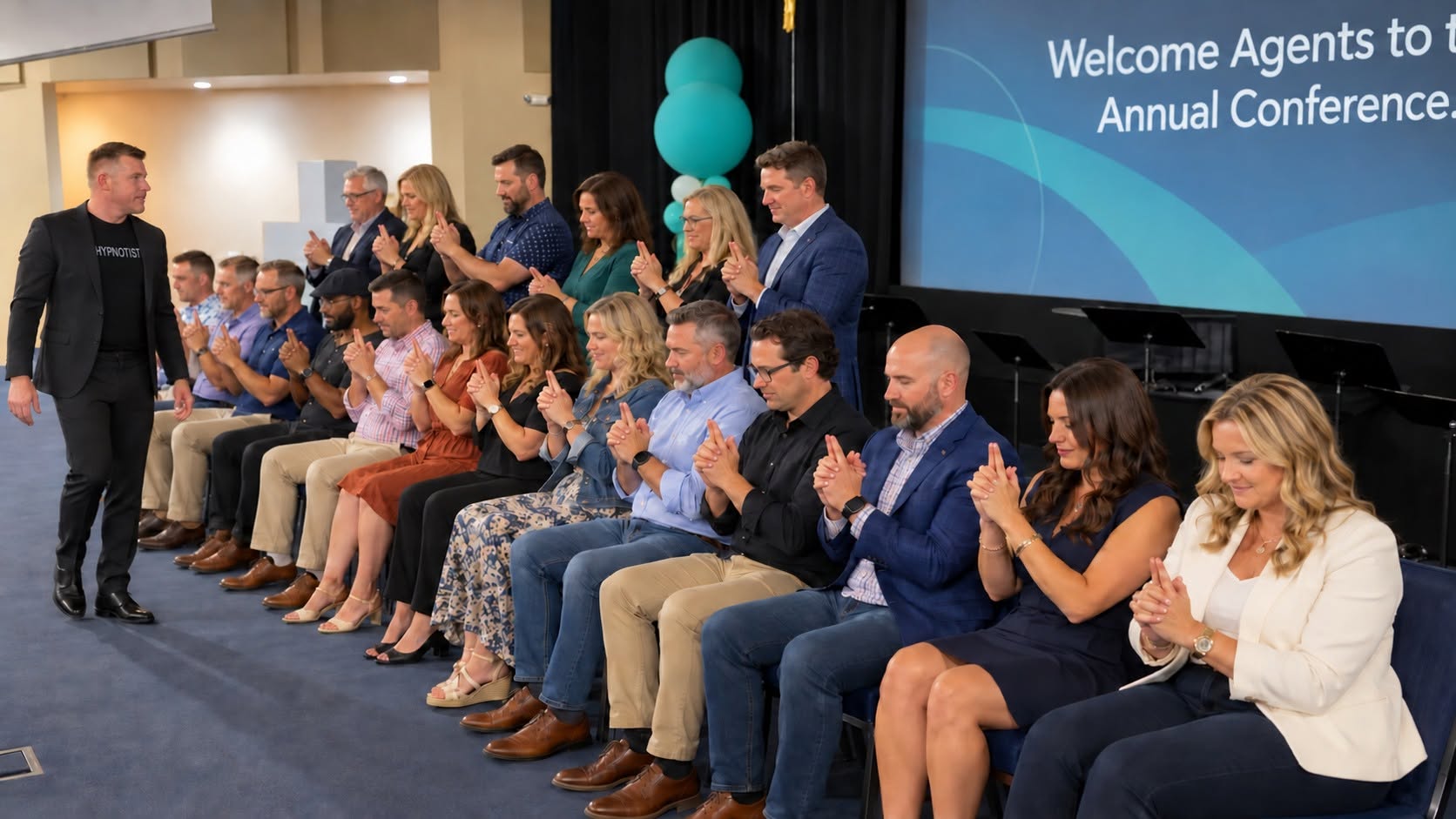

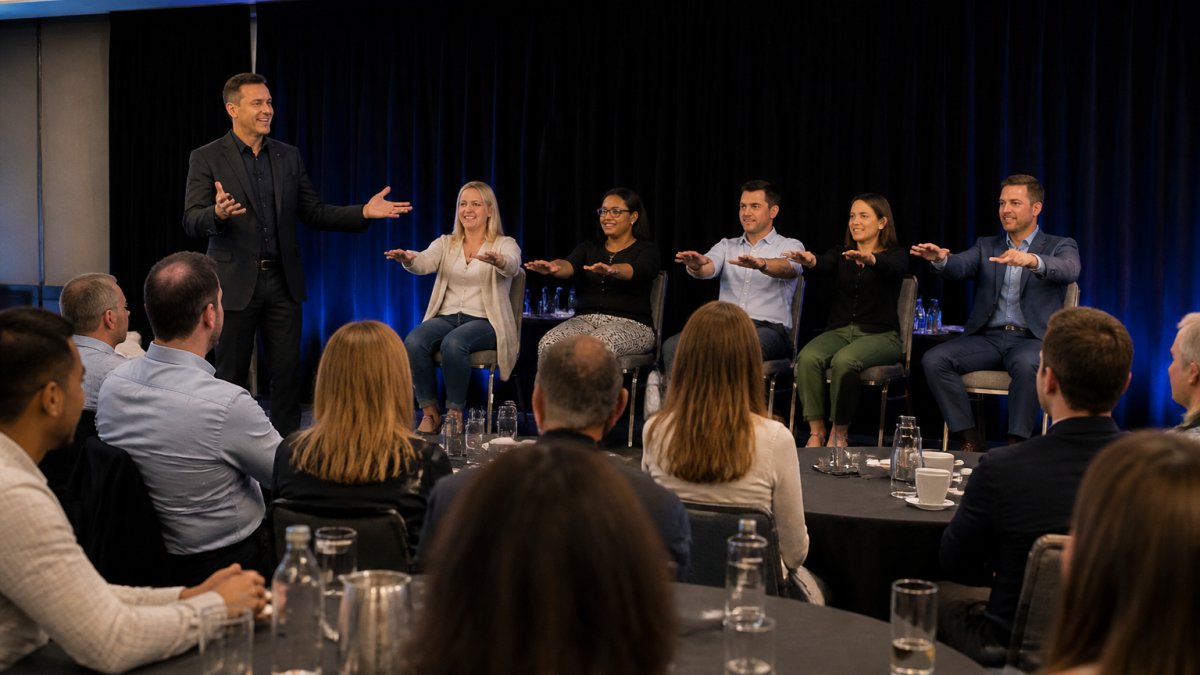
Table of Contents

Last Updated: October 16, 2026

Why 2026 Corporate Event Entertainment Needs a Different Approach

Corporate event entertainment is the lineup of performers, games, and hands-on experiences you book to keep a room of employees engaged from the first hour to the last. In 2026, that job is harder than it used to be. Hybrid schedules mean people see each other less, so the one night you get everyone in a room has to count.

At Dusty Satterlee, we have spent over 15 years performing comedy stage hypnosis and mentalism for schools, colleges, and companies. The pattern is clear: passive entertainment loses the room. A speaker talks, people check phones. A band plays, people talk over it.

The fix is participation. The best corporate event entertainment ideas in 2026 put employees on stage, in teams, or behind a controller instead of in a chair. Below, we break down what works, what it costs in general terms, and how to match an idea to your actual goal.

Interactive Corporate Event Ideas That Get Everyone Involved

Interactive corporate event ideas work because they turn the audience into the show. The format matters less than the participation rate. If half the room is watching and half is doing, you have a hit.
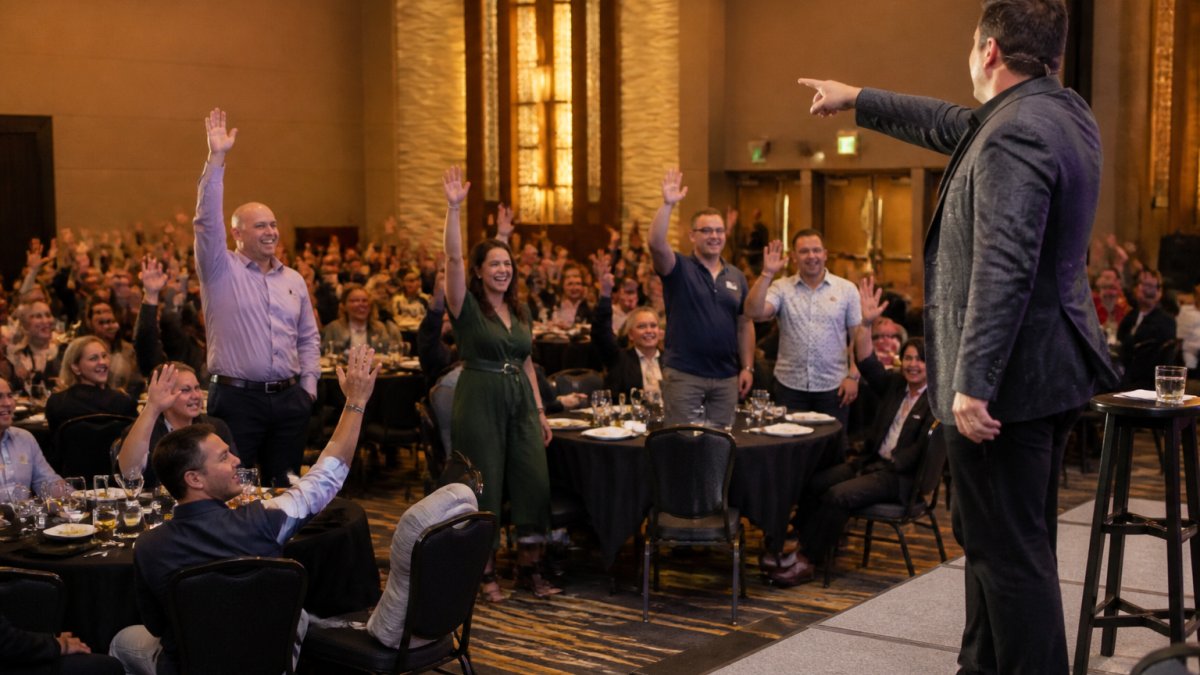
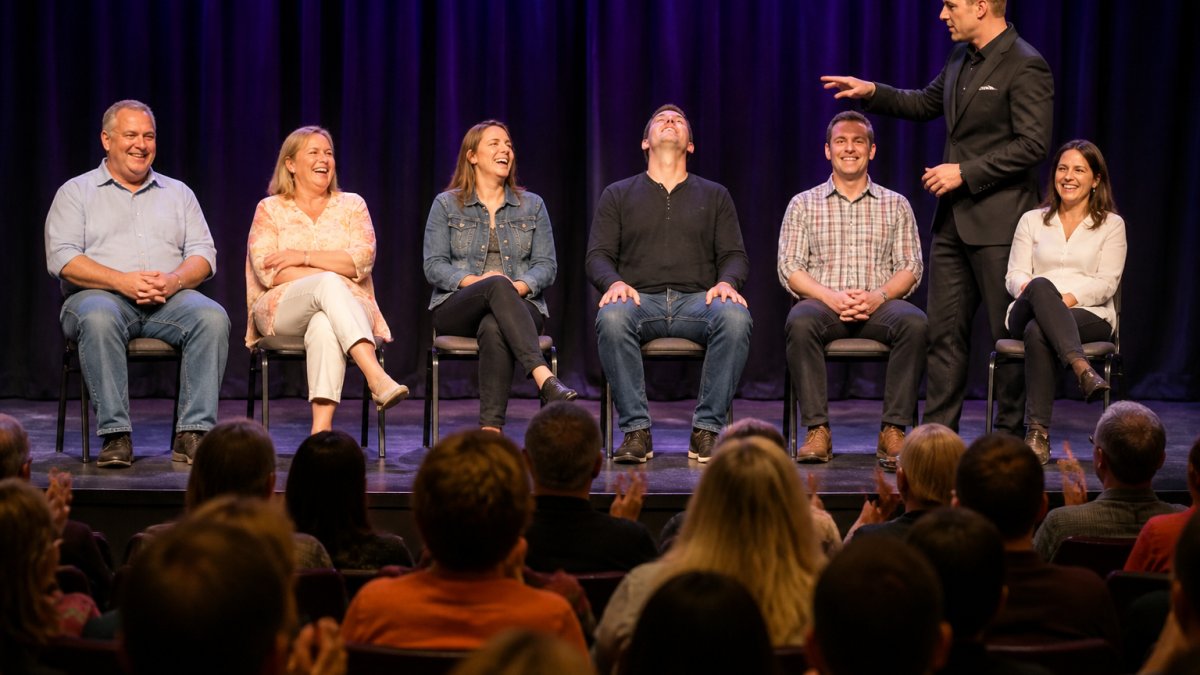
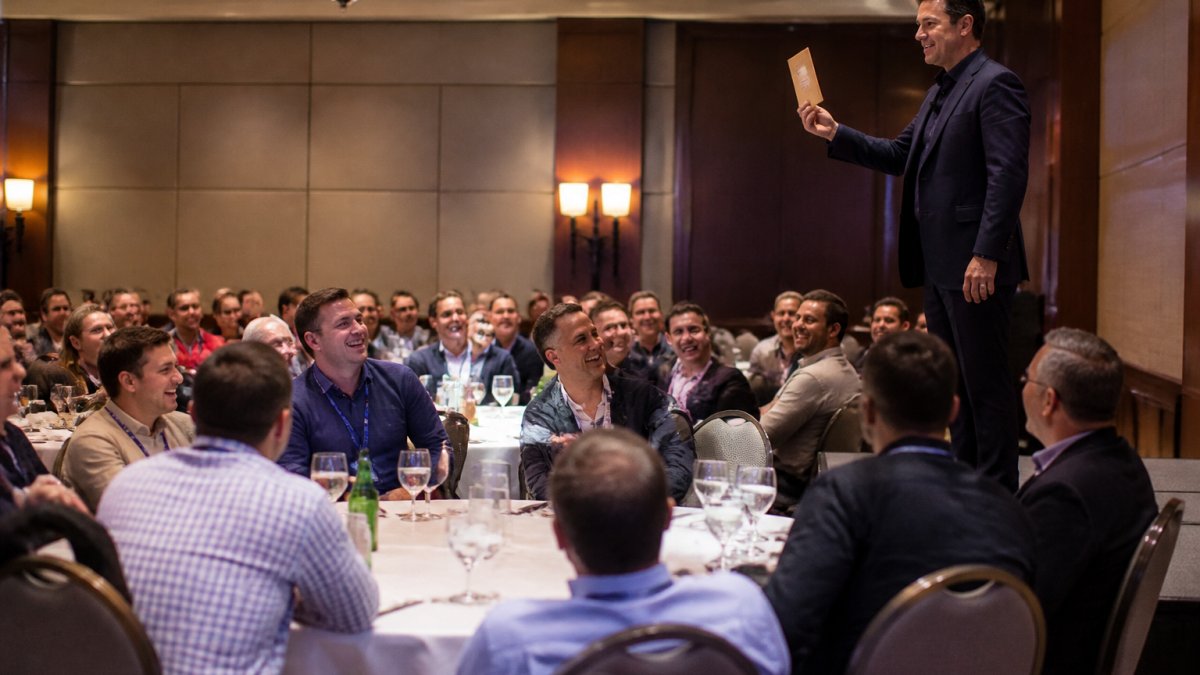
A diverse group of corporate employees laughing and raising hands as a stage performer invites volunteers up during a company event, warm stage lighting, packed banquet room with round tables

Live Music, Comedy Hypnosis, and Stage Performances

Live music sets a mood, but it rarely creates a shared memory on its own. Stage performances do, when they pull people up. Comedy hypnosis and mentalism sit in a sweet spot here: volunteers become the stars, and the rest of the room cannot look away.

A common mistake is booking a show that only works for the front row. Ask any performer how they handle a crowd of 400, not 40. The answer tells you whether the act scales.

Games, Competitions, and Team Challenges

Competitions give quiet employees a reason to cheer. Strong options include:

  • Trivia and quiz nights with department teams
  • Board game tournaments with a bracket on a big screen
  • Escape-style puzzle challenges run in small groups
  • Cornhole, mini golf, and axe throwing lanes
  • Racing and golf simulators for the competitive crowd
  • Esports tournaments for younger teams
Pro Tip
Run competitions in mixed-department teams. It breaks silos better than any icebreaker, and people remember who they played with long after the event.

Corporate Event Activities for Employees: Matching Ideas to Your Goals

Corporate event activities for employees should be chosen backward from the goal. Pick the outcome first, then the entertainment.

Goal Best Format Why It Works
Boost morale Comedy hypnosis or mentalism show Volunteers become the story
Build teams Games and competitions Forces cooperation
Teach skills Hands-on workshop People practice, not watch
Reward top performers Live music and cocktail bar Feels like a celebration
Connect remote staff Immersive or virtual experience Levels the room

For employee appreciation, lean toward a show with audience participation. For team building, lean toward a challenge. For networking, food, drink, and a pop-up bar do more than any stage act.

Corporate Event Entertainment on a Budget: What Actually Works

Most ranking articles list entertainment ideas and stop. Almost none show what the ideas cost, which is the first question a planner asks. This section gives realistic cost bands, the drivers that move a quote up or down, and lower-cost swaps that keep the room engaged.

Realistic Cost Bands by Format

Treat these as planning ranges for a single evening, not quotes. A performer’s fee depends on date, travel, set length, and how many people are in the room.

Format Typical Range What Drives the Price
In-house trivia or board game tournament $0-$500 Staff time, prizes, printing
Photo booth (open-air or enclosed) $500-$2,500 Hours, prints vs. digital-only, attendant
DJ $800-$2,500 Set length, gear, travel
Comedy hypnosis or mentalism show $2,500-$10,000 Headliner status, audience size, travel
Live band (regional) $2,000-$6,000 Number of players, hours, backline
Headline musician $15,000-$100,000+ Name recognition, rider, production
Full VR or immersive build $10,000-$50,000+ Number of headsets, custom content, staffing
Mixology or cocktail workshop $1,500-$5,000 Guest count, spirits, bartender ratio

A common pattern is that the per-person cost drops sharply as the audience grows. Participation-based acts often scale well for larger groups.

What Actually Moves the Quote

Five drivers explain most of the variance between two quotes for the same act:

  • Date. December and year-end weeks carry a premium. Off-peak weeknights are the cheapest slot on the calendar.
  • Travel. Flights, hotel, and per diem are usually billed on top of the fee. Booking a regional act cuts this line to near zero.
  • Set length. A 45-minute show and a 90-minute show are not priced the same, even for the same performer.
  • Audience size. Larger rooms need bigger sound, more mics, and sometimes a second performer.
  • Production. A raised stage, lighting package, and backline rental can add thousands before the act walks in.

Lower-Cost Swaps That Still Land

If the budget is tight, swap down the format, not the participation rate:

  • Replace a headline musician with a regional band plus a DJ for the after-set.
  • Replace a full VR build with a single racing or golf simulator and a bracket on a screen.
  • Replace a paid trivia host with a staff emcee and a prize budget.
  • Replace a cocktail workshop with a signature-drink station and a printed recipe card.
Pro Tip
Ask every vendor for an all-in number: fee, travel, production, and tax. The gap between a quoted fee and the final invoice is usually travel and gear, and it is the most common budget surprise.

Where Costs Climb Fast

Live bands, headline musicians, full virtual reality setups, and celebrity bookings are the four formats that routinely blow past the planning range. Each one carries a production layer, sound, staging, staffing, or content, that is priced separately from the talent. Get those line items in writing before you commit.

Book A Show →

Key Takeaway
The cheapest entertainment is not the lowest fee. It is the format that keeps the highest share of the room participating for the longest stretch of the night.

Corporate Holiday Party Entertainment Ideas for 2026

Corporate holiday party entertainment ideas for 2026 are shifting toward shared experiences over spectacle. A virtual concert or digital entertainment stream can work for remote teams, but in-person crowds want to be part of the action.

Event industry trends and attendee experience research

What holds up at holiday parties: a headliner act with audience participation, a mixology workshop or cocktail bar, an espresso bar for the early leavers, and a photo booth that doubles as a keepsake. Add a short awards moment and you have a full night.

Watch Out
Skipping an accessibility check is the most common holiday party mistake. Strobe lights, loud bursts, and forced participation push some employees out of the room. Ask about sensory needs before you book.

How to Choose the Right Corporate Event Entertainment

Choosing the right corporate event entertainment means matching three things: your goal, your audience, and your venue. Get those aligned and the booking decision gets simple.

Accessibility, Sensory Considerations, and Inclusive Planning

Inclusive planning is not a nice-to-have. It decides who stays in the room. Under the Americans with Disabilities Act requirements, event spaces need accessible seating, paths, and restrooms. Go further than the law requires:

  • Offer a quiet room for anyone who needs a break
  • Warn guests about strobe lights, smoke, or sudden loud sounds
  • Make participation optional, never forced
  • Confirm captions or interpreters for any spoken act
Key Takeaway
The best corporate event entertainment gives every guest a way to take part at their own comfort level. Optional participation keeps the room full.

Logistics, Venue Requirements, and Measuring Success

Logistics decide whether a great act lands. A stage show needs a raised platform, power, and clear sightlines. Simulators and axe throwing need floor space and safety clearance. Photo booths need a corner and an outlet.

Measure the outcome with simple signals: how many people volunteered, how many stayed to the end, and what they said the next day. A short survey beats guessing.

Meeting Professionals International event planning resources

A common mistake is booking entertainment before checking the venue. Confirm ceiling height, power, load-in access, and noise limits first.

Frequently Asked Questions

What are some fun themes for corporate events in 2026?

Popular themes for 2026 include immersive experiences like escape-style challenges, virtual reality tournaments, and interactive performances such as comedy hypnosis or mentalism shows. Other strong options are mixology workshops, pop-up casino nights, and team-based quiz competitions. The best theme depends on your audience and event goal: a holiday party might suit a glamorous casino night, while a team-building retreat works well with hands-on workshops or competitive games that encourage collaboration and audience participation.

How do you choose entertainment for a corporate event?

Start by defining your event goal, whether that is employee engagement, networking, or pure celebration. Then match the entertainment to your audience size, venue, and budget. Interactive experiences like stage hypnosis, mentalism, or team competitions tend to drive higher participation than passive performances. Always ask for references and video of a full performance, not just a highlight reel, to confirm the entertainer delivers consistently in person.

What interactive entertainment works well for a company event?

Interactive options that consistently perform well include comedy stage hypnosis, mentalism shows with audience volunteers, trivia and quiz competitions, escape-style challenges, board game tournaments, and hands-on workshops like mixology or meditation sessions. These formats get employees out of their seats and talking to each other, which boosts engagement far more than a passive concert or speaker. For larger groups, a headline performer paired with smaller breakout activities gives everyone something to do.

How long should entertainment last at a corporate event?

Most corporate entertainment works best in a 45 to 60 minute block for a headline act, with 15 to 30 minutes for supporting activities or opening segments. If you are planning a full evening, consider splitting entertainment into two parts: an interactive icebreaker early on and a main performance after dinner. This keeps energy high and prevents audience fatigue. Always confirm timing with your performer in advance and build in buffer time for setup and transitions.


The hardest part of planning is not finding entertainment. It is finding entertainment that keeps 400 people off their phones. Dusty Satterlee solves that with a tasteful blend of comedy stage hypnosis and mentalism, backed by over 15 years of experience and training under veterans like Michael C. Anthony. Volunteers become the show, the room stays engaged, and guests talk about it for weeks. Book a show with Dusty Satterlee and give your team a night they will actually remember.
Last Updated: October 29, 2026

Quick Summary

Booking high energy corporate entertainment starts with a clear brief covering your event goals, audience size, budget range and desired tone, then requesting full-length performance videos to confirm the performer’s style fits your crowd before signing a contract. Interactive formats like comedy stage hypnosis and mentalism work best because they turn spectators into participants.

  • Interactive formats invite volunteers on stage and adapt to the room, while passive acts keep audiences watching.
  • Place your headliner where energy peaks, usually after dinner or mid-program when attention drifts.
  • Send the technical rider to the venue’s AV contact at least two weeks before the event for written confirmation.
  • Build budgets in three layers: performance fee, production and AV add-ons, and contingency.
  • Send a post-event survey within 48 hours, since response rates drop sharply after two days.

Table of Contents

Why High Energy Corporate Entertainment Decides Your Event’s Success

Booking high energy corporate entertainment is the difference between an event people talk about on Monday and one they forget by the parking lot. The room always tells you the truth.

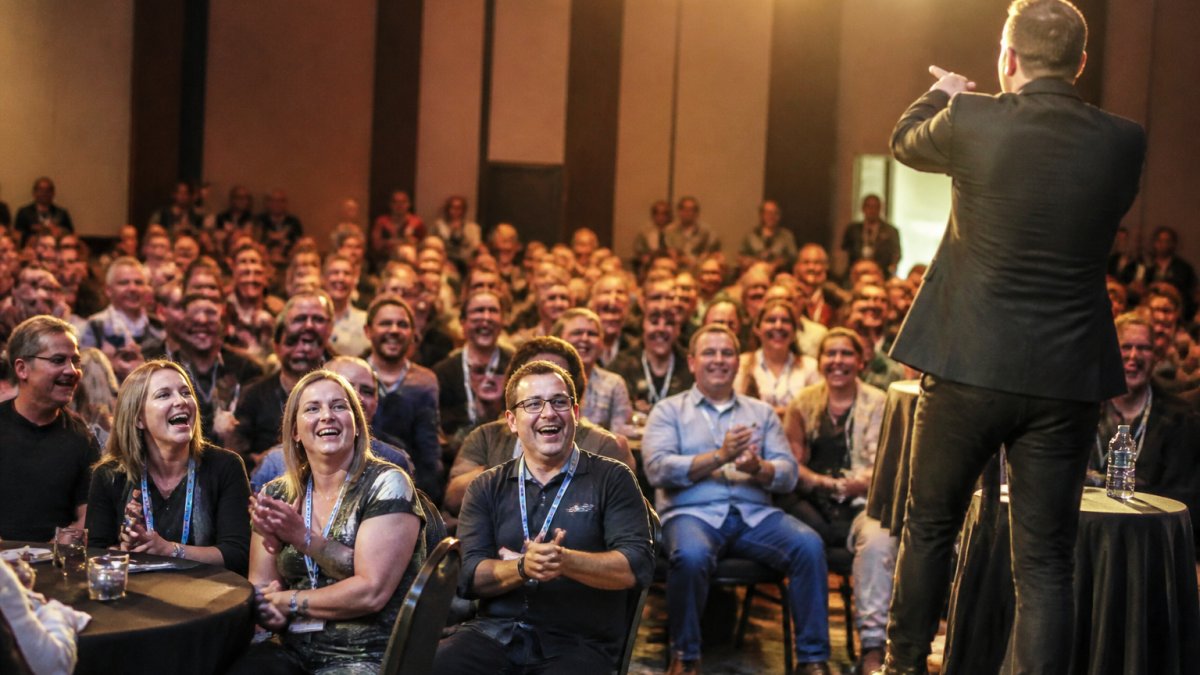
A packed audience applauds a performer during a high energy corporate entertainment event on stage.

What Separates Memorable Entertainment From a Forgettable Show

The gap comes down to audience participation. Passive acts ask people to watch. High-energy performers ask them to participate, and that shift changes the entire mood of a room. A comedy stage hypnosis or mentalism show pulls volunteers up, gives the crowd a shared story, and turns spectators into participants. That shared experience is what attendees remember, and it’s why event planners keep coming back to interactive formats.

Corporate Event Entertainment Ideas That Fill Seats and Keep Them

High-energy formats give the audience a role. Comedy stage hypnosis and mentalism put people at the center of the action. If you want a broader menu of formats to compare before you commit, our list of corporate event entertainment ideas covers the options side by side.

Interactive Formats vs. Passive Performances

Interactive entertainment invites volunteers on stage and adapts to the room. Passive performances, like a band or a keynote, keep the audience seated and watching. Both have a place, depending on your goals.

How to Book Corporate Entertainment Without the Guesswork

Booking corporate entertainment starts with a clear brief: your event goals, audience size, budget range, and the tone you want. From there, request performance videos and confirm the performer’s style matches your crowd before you sign a performance contract. A practical method for judging footage makes this far easier.

Questions to Ask Before You Sign a Performance Contract

Ask these before committing:

  1. Can you share full-length performance footage, not just a highlight reel?
  2. How do you tailor material to our audience demographics and event theme?
  3. What is your technical rider, and what AV do you need from us?
  4. What is your cancellation and backup plan if illness strikes?

Building a Corporate Event Run of Show Around Your Headliner

Your corporate event run of show should place the headliner where energy peaks, usually after dinner or mid-program when attention starts to drift. Build a buffer before and after the performance for setup, audience transition, and applause. Keep the entertainment block clearly timed so event logistics stay on schedule. A tight event timeline protects the performer’s stage time and keeps the attendee experience smooth from arrival to close.

Technical Rider and AV Requirements Most Planners Overlook

A technical rider is the document listing everything a performer needs to deliver the show: sound, lighting, stage space, and backstage access. Most planners overlook how much a strong rider protects the event, and how many day-of failures trace back to a rider that was skimmed instead of reconciled with the venue. You can watch performance videos to see the staging, AV needs, and audience energy in action.

What a High-Energy Act’s Rider Typically Covers

Confirm each rider item in writing with both the performer and the venue before the event.

  • Stage and performance area. Minimum stage dimensions, clearance to the ceiling, and a clear path from the stage to the audience for volunteer transitions. Interactive formats need room for participants to walk up and back safely.
  • Sound. A handheld wireless microphone for the performer, plus at least one spare wireless mic and fresh batteries. A lavalier is usually not sufficient for a show that moves around the stage. Confirm the venue’s sound system can patch into the performer’s playback device (often a laptop or phone via a DI box or 3.5mm/USB input).
  • Lighting. A general stage wash that keeps the performer’s face visible, plus the ability to bring house lights up and down on cue. Interactive shows depend on the performer reading audience faces, so a blacked-out room is a real risk.
  • Playback and cues. A designated AV operator who can run walk-in music, show playback, and lighting cues. Ask who that person is by name and confirm they will be on site for the full performance block.
Pro Tip
Send the rider to the venue’s AV contact at least two weeks before the event and ask for a written confirmation line by line. A verbal “we have all that” is the most common source of day-of surprises.

How to Reconcile the Rider With Your Venue

Run a check between the performer’s rider, the venue’s AV capabilities, and your run of show. The practical sequence:

  1. Get the rider from the performer in writing.
  2. Send it to the venue’s event or AV manager and request a written gap list.
  3. Price any rentals (extra wireless mic, DI box, cable ramps) and add them to the event budget.
  4. Confirm the AV operator’s name and on-site hours in the final run of show.
  5. Do a sound and mic check in the actual room during load-in, not in a rehearsal hall.

Budgeting for Corporate Entertainment and Measuring Post-Event ROI

Corporate entertainment budgeting depends on the performer, the date, and the scale of production, so pricing is best confirmed directly with the performer. What you can control is how you frame the spend to leadership and how you measure event success metrics afterward.

Book A Show →

How to Frame the Budget Before You Request Quotes

Build the budget in three layers so quotes are comparable across performers:

  • Performance fee. The performer’s base fee for the date and show length. Request quotes rather than anchoring on a number.
  • Production and AV add-ons. Rentals the rider requires that the venue does not already own, extra wireless mics, a DI box, cable ramps, additional stage lighting. These are often the line item planners forget.
  • Contingency. A reserve for date changes, added show time, or a backup performer if illness strikes.
Key Takeaway
Ask every performer for a quote broken into these layers. A single all-in number makes it impossible to compare offers or to explain the spend to finance.

Measuring Post-Event ROI: A Practical Framework

The real question leadership will ask is whether the entertainment improved employee engagement or event success. You do not need a research team to answer it, you need to capture the right signals before, during, and after the event.

Stage What to Track How to Capture It Why It Matters
Pre-event Booking confirmations, AV checklist, baseline engagement survey Written confirmations; a short pre-event pulse survey Establishes a baseline so post-event scores mean something
During event Audience participation rate, phone use, volunteer count, laughter/applause cues AV operator and event staff observation log Shows real engagement, not just attendance
Post-event Survey scores, social mentions, referrals, hallway conversation A 3-5 question post-event survey sent within 48 hours; social listening Proves ROI to leadership and informs the next booking

A few practical notes on each:

  • Baseline first. Send a short pre-event survey (three to five questions on team morale and event expectations) so post-event scores have a comparison point. Without a baseline, a “good” score is just an opinion.
  • Observation log during the show. Have one staff member note volunteer count, how many attendees are on their phones during the performance block, and whether the crowd stays after the show. These are leading indicators of engagement.
  • Post-event survey within 48 hours. Ask attendees to rate the entertainment, whether they would attend a similar event again, and one open-ended question about what they remember. Response rates drop sharply after two days.
  • Social and referral signals. Track mentions of the event and the performer, and ask whether attendees mentioned the show to colleagues. Referrals are the clearest sign the entertainment created a shared story.
Pro Tip
Tie the ROI story to the event’s stated goal. If the goal was team morale, report survey movement and volunteer participation. If the goal was client entertainment, report social mentions and referrals. The same show can be measured against different goals, pick the one leadership already cares about.

That post-event ROI measurement is the angle most planners skip, and it’s the one that justifies the spend to leadership.

Book a Show That Gets Your Audience Talking

The real test of corporate entertainment isn’t the applause. It’s the conversation in the hallway afterward. When a performer connects with the crowd, the event becomes a story people retell for weeks, and that’s the outcome worth planning around.


If your next event needs entertainment that actually lands, Dusty Satterlee brings world-class comedy stage hypnosis and mentalism with a tasteful, elegant style built for corporate audiences. Ready to give your audience something to talk about? Book a show through the Dusty Satterlee website to request current availability and a quote.

Frequently Asked Questions

How do you book entertainment for a corporate event?

Start by defining your event goals, audience size, and budget, then shortlist performers whose style matches your theme. Contact the entertainer or agency directly, request video of a full live show rather than a highlight reel, and confirm availability for your date. Ask for a written performance contract covering the technical rider, load-in time, cancellation policy, and payment terms. Book four to six months ahead for peak seasons, and lock in the run of show details at least two weeks before the event.

What should you ask a corporate entertainer before booking?

Ask how many live shows they have performed for audiences like yours, what happens if they fall ill or cannot travel, and whether they carry liability insurance. Request their technical rider so your venue can confirm power, stage, and sound requirements. Ask how they customize material for audience demographics and event themes. For school or corporate audiences, ask specifically how they keep content tasteful and appropriate, and whether they can dial back audience participation if needed.

How long should entertainment last at a corporate event?

A headline performance typically runs 45 to 60 minutes, which keeps energy high without exhausting the crowd. Interactive formats like comedy hypnosis or mentalism often work best in a single focused block rather than split segments. Build 15 to 20 minutes of buffer around the show in your run of show for introductions, load-in, and audience settling. If entertainment anchors a longer program, pair a 45-minute headline set with shorter warm-up activities earlier in the evening.

How can you make corporate event entertainment engaging but professional?

Choose performers who tailor content to your audience and avoid material that targets individuals in ways that could embarrass them. Interactive entertainment works well when participation is voluntary and the performer reads the room. Brief the entertainer on your corporate culture, any topics to avoid, and the seniority mix in the audience. A performer with stage presence and experience across corporate and school settings will adjust tone in real time, keeping energy high without crossing lines.

Does high energy entertainment work for smaller audiences and tighter budgets?

Yes. Interactive formats like comedy hypnosis and mentalism scale from a few hundred students to large corporate crowds, and pricing depends on date, travel, and show length rather than audience size alone. For smaller budgets, consider a single headline block instead of multiple performers, or pair the show with existing event programming. Ask the entertainer directly for a quote based on your specific event rather than assuming a large-crowd price.

How do you measure whether corporate entertainment was worth the investment?

Track attendance against projections, survey attendees within a week about engagement and overall event satisfaction, and note social media mentions or photos shared during and after the show. Compare post-event survey scores to previous events without headline entertainment. For fundraisers, measure donations or ticket sales against prior years. Qualitative signals matter too: whether people stayed off their phones, talked about the show the next day, and whether leadership asks to book again.

Last Updated: October 26, 2026

Quick Summary

Stage hypnosis is safe for schools when it is treated as a managed event with clear boundaries, not a proven-harmless one. Volunteers keep the ability to resist suggestions they find objectionable, and most incidents at school shows are social rather than hypnotic. Schools should ask performers about safeguarding, consent, and distress procedures before booking.

  • No large body of controlled research exists on stage hypnosis with minors in schools.
  • Elementary audiences are generally a poor fit for a full stage hypnosis show.
  • High school is the most common booking, where peer pressure is sharpest.
  • Ask performers how they handle a volunteer who becomes upset on stage.
  • Do not let a distressed volunteer walk back to their seat unaccompanied.

Table of Contents

What Stage Hypnosis Is and How It Works

Stage hypnosis is a performance art built on focused attention, vivid imagination, and willing cooperation, not sleep and not mind control. A performer guides volunteers into a relaxed, absorbed state, then offers suggestions that play out as comedy.

That definition settles most of the anxiety around is stage hypnosis safe for schools. Dusty Satterlee performs for high schools, colleges, and corporate functions, drawing on over 15 years of experience.

Here is the mechanism in plain terms:

  • Focus narrows. Volunteers stare at a fixed point or listen to a steady voice and tune out the room.
  • Imagination takes over. A suggestion like “your eyelids feel heavy” becomes real because the participant pictures it.
  • Expectation does the rest. People who volunteer expect to be entertained, and that expectation shapes their response.

The key point: nobody can be made to do something against their values. A hypnotized volunteer who hears a suggestion they dislike simply ignores it, opens their eyes, or walks off stage. That is how the act works.

Stage Hypnosis Risks for Students and Teenagers

Administrators considering stage hypnosis can set clear boundaries and ask questions about safety.

Stage hypnosis is entertainment.

What is reasonably well established:

  • Hypnosis is a state of focused attention, not a loss of will. The American Psychological Association’s overview of hypnosis describes hypnosis as focused attention and reduced peripheral awareness, with an enhanced capacity for response to suggestion. People retain the ability to resist suggestions they find objectionable.
  • Response varies widely. Not everyone is highly responsive, which is why performers run a group test before inviting volunteers up. A student who does not respond strongly is simply not a good stage candidate.
  • Most stage-show incidents are social, not hypnotic. Embarrassment, peer pressure, filming, and crowd behavior account for the overwhelming majority of bad outcomes at school events.

What is genuinely uncertain, and should be stated as such:

  • There is no large body of controlled research on stage hypnosis with minors in schools. Claims in either direction, “completely safe” or “dangerous for developing brains”, outrun the evidence. Treat the show as a managed event, not a proven-harmless one.
  • Individual vulnerability is not reliably screened at the door. A performer can ask about seizure history and anxiety, but cannot diagnose. That is why the pre-show briefing and the opt-out matter more than any screening form.
  • Rare adverse reactions are reported anecdotally. Most practitioners describe occasional dizziness, tearfulness, or a volunteer who feels “off” afterward, resolving with rest and a calm conversation. Serious outcomes are rare, but no honest performer will promise they never happen.

Age and school context change the calculus:

  • Elementary audiences. A full stage-hypnosis show is generally a poor fit: shorter attention spans, less reliable consent understanding, and a higher chance of misunderstanding a suggestion. Most experienced performers decline elementary bookings or offer a non-hypnosis variety show.
  • Middle school. Workable with tighter limits: fewer volunteers, shorter bits, a staff member within arm’s reach of the stage, and no suggestions touching body image or social status, the two topics most likely to land badly with early adolescents.
  • High school. The most common booking, and where peer pressure is sharpest. The risk is rarely the hypnosis; it is the friend who shoves a reluctant classmate forward. Staff positioning and a clearly announced opt-out do more good than content restrictions.
  • Prom, graduation night, and after-school events. Consent logistics get harder because parents are not present. If your school requires guardian permission for after-school participation, collect it in advance rather than at the door.

A school show is entertainment.

Age and school context change how a stage hypnosis show should be handled.

Audience or event Fit Key consideration
Elementary audiences Generally a poor fit Shorter attention spans, less reliable consent understanding
Middle school Workable with tighter limits Fewer volunteers, shorter bits, staff within arm’s reach
High school Most common booking Peer pressure is sharpest; staff positioning and announced opt-out
Prom, graduation night, after-school events Consent logistics get harder Parents not present; collect guardian permission in advance

School Assembly Entertainment Safety Checklist

A school assembly entertainment safety checklist can help organize planning. Use this one before you sign a contract and again on the day.

Before booking:

  • Review video of a full performance, not just a highlight reel

Two weeks out:

  • Brief teachers and chaperones on their role during the show

On the day:

  • Check the stage for trip hazards and clear access on and off

Audience selection is an important consideration. A performer can ask for volunteers.

Voluntary participation is an important consideration. Schools can determine whether they require parent or guardian consent for after-school events like prom or graduation night.

Schools can remind students that participation is optional.

Book A Show →

School Assembly Performer Questions to Ask Before Booking

These questions can help guide a conversation with a school assembly performer. Ask directly and listen for specific answers.

On experience and training:

  • How many school shows have you performed, and at what grade levels?
  • What formal training have you completed in hypnosis?
  • Are you a member of a professional hypnosis organization?

On safety and safeguarding:

  • What is your process if a volunteer becomes upset on stage?
  • Do you carry liability insurance?
  • Will you sign and follow our safeguarding policy?
  • How do you handle a student who wants to leave the stage?

On content:

  • How do you keep the material age-appropriate?
  • What topics are off-limits?
  • Can you adjust the show for a younger audience?

On logistics:

  • What happens if you are ill or cannot travel on the day?
  • What is your cancellation policy?
  • What are your technical and space requirements?

The answers tell you a lot. A performer who hesitates on the distress question, or brushes off the safeguarding policy, is telling you something important.

This is also where you vet a school hypnotist properly. Dusty Satterlee draws on over 15 years of experience and training from Michael C. Anthony and the Mike Mandell Hypnosis Academy.

Building an Age-Appropriate Hypnosis Show

Dusty Satterlee’s performances combine comedy stage hypnosis and mentalism in a tasteful and elegant style.

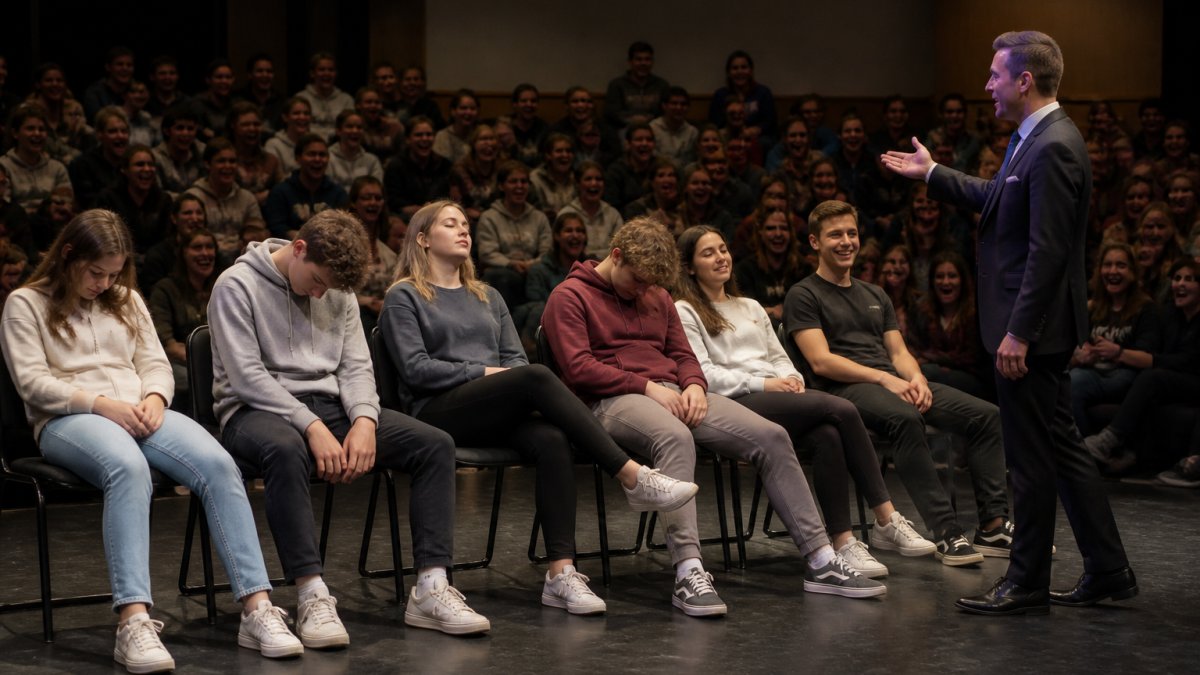
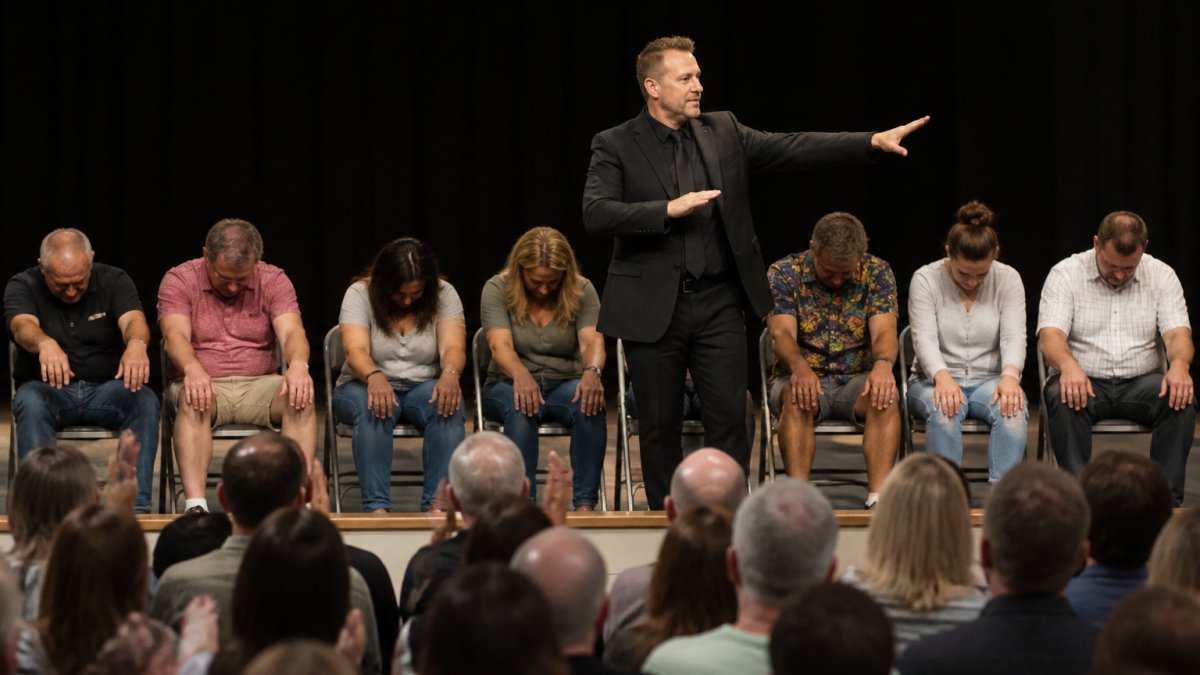
A stage hypnotist performing a safe stage hypnosis show for smiling high school volunteers on an auditorium stage.

What works for high school and college crowds:

  • Imagined scenarios. Volunteers believe they are stuck to the chair, or that the room is freezing, or that they are on a roller coaster.
  • Physical comedy. Suggestions that produce visible, funny movement without anyone touching anyone else.
  • Group bits. Several volunteers reacting to the same suggestion at once, which spreads the attention and reduces pressure on any one student.
  • Music and timing. A good soundtrack and a brisk pace keep the energy up.

The tone matters as much as the content. Dusty Satterlee’s performances are described as tasteful and elegant.

What Happens If a Student Becomes Distressed

Watch Out
Do not let a distressed volunteer walk back to their seat unaccompanied, and do not resume the show with that student in the audience until they are oriented and calm. The instinct to minimize disruption is understandable, but an unaccompanied exit is the single most common procedural miss at school events.

The Centers for Disease Control and Prevention’s guidance on school mental health supports having a calm, supervised space and a trusted adult available at school events. That is good practice for any assembly, hypnosis show or not, which is the point. A well-run hypnosis show does not require a special crisis plan; it requires the same supervision and quiet-room setup a school should already have for any large event, applied deliberately.

One more detail worth discussing with the performer in advance is how they would respond if a volunteer became distressed.

Book a School Hypnosis Show That Puts Safety First

Booking a school hypnosis show is a decision about trust as much as entertainment. The schools that get it right ask hard questions, set clear boundaries, and choose a performer who treats students with care.

Dusty Satterlee’s performances combine world-class mentalism and hypnosis in a tasteful, elegant style. Dusty brings over 15 years of experience, training from veteran international stage hypnotist Michael C. Anthony and the Mike Mandell Hypnosis Academy, and membership in Stage Hypnosis University.

An Edinburg High School Post Prom customer said: “They did an amazing job!! He was prompt and all of our students and volunteers at Edinburg High School’s Post Prom really enjoyed him and his helper!!”

If you are weighing whether stage hypnosis is right for your assembly, prom, or graduation night, start with a conversation. Get started with Dusty Satterlee and book a show.

Frequently Asked Questions

Is stage hypnosis safe for students?

Schools can ask performers about training, insurance, and consent procedures before booking.

What are the risks of stage hypnosis for teenagers?

Schools can ask performers about their experience and discuss event-planning considerations before booking.

Can someone get stuck in hypnosis?

The verified facts describe stage hypnosis as entertainment but do not establish whether someone can get stuck in hypnosis.

What should a school ask a hypnotist before booking?

Ask about the performer’s training and experience. You can also discuss how the show fits your event and ask questions about student participation.

Last Updated: October 23, 2026

Quick Summary

Interactive stage shows for colleges make the audience the show, turning spectators into participants through formats like comedy hypnosis, mentalism, improv, game shows, and murder mysteries. Book them 4-6 months out, match the format to your crowd and goals, and keep participation voluntary with a host who explains the process and offers a graceful way to decline.

  • Define attendance, engagement, and budget goals 4-6 months before the event date.
  • Read the technical and hospitality rider against the actual venue before signing the contract.
  • Build budgets around fee, travel, per diem, venue costs, promotion, and a contingency reserve.
  • Assign one student liaison and one tech contact, and reserve parking and security weeks ahead.
  • Measure success through attendance, volunteer rate, post-event chatter, survey scores, and repeat requests.

Table of Contents

Why Interactive Stage Shows Work on Campus

Interactive stage shows for colleges solve a problem no speaker, band, or movie night can touch: they make the audience the show. At Dusty Satterlee, we have spent 15 years watching student crowds transform the moment a volunteer steps on stage.

A campus performance with real audience participation turns spectators into participants. Students are not watching a stranger’s story. They are watching their roommate, their lab partner, their RA. That shift changes the entire energy of a venue.

The benefits for colleges are practical:

  • Attendance: Students show up because word travels fast when the crowd becomes the cast.
  • Student engagement: A shared live performance gives the class something to talk about for weeks.
  • Inclusion: Everyone in the room has a stake in what happens next.

The National Association for Campus Activities has long tracked how live performance shapes student life on campus. Their member schools consistently rank shared events among the strongest tools for building community.

Formats That Pull Students Off Their Phones

Not every stage show earns attention. The formats that work share one trait: the audience can change the outcome.

  • Comedy stage hypnosis: Volunteers become the stars, guided through tasteful, funny scenarios.
  • Mentalist shows: The performer reads the room and involves students in mind-reading demonstrations.
  • Improv troupes: Audience suggestions drive every scene.

Each format carries a different risk level. Comedy and mentalism stay low-pressure. Improv and game shows need strong hosting to keep pace. A good producer will match the format to your crowd size and event goals.

Pro Tip
Ask any performer how they handle a volunteer who freezes up mid-bit. The answer tells you more about their experience than any promo video. A seasoned host has a graceful exit ready and never makes the student feel foolish.

College Orientation Entertainment That Sets the Tone

Orientation week is the hardest booking of the year: a room full of strangers, a schedule packed with logistics, and one shot at making the incoming class feel like they belong.

A comedy stage show fits that brief well. New students see classmates volunteer, laugh together, and leave with inside jokes before the first day of class.

What to look for in orientation programming:

  • Fast setup: Orientation schedules run tight, so the show must load in and out quickly.
  • Broad appeal: The humor has to land with a diverse incoming class.
  • Voluntary participation: No one should feel pressured to volunteer.

The American College Personnel Association frames orientation as a key moment for student connection. Entertainment that builds that connection early pays off all year.

What a College Hypnosis Show Looks Like in Practice

A college hypnosis show is a comedy performance where student volunteers, with their consent, become the center of the act.

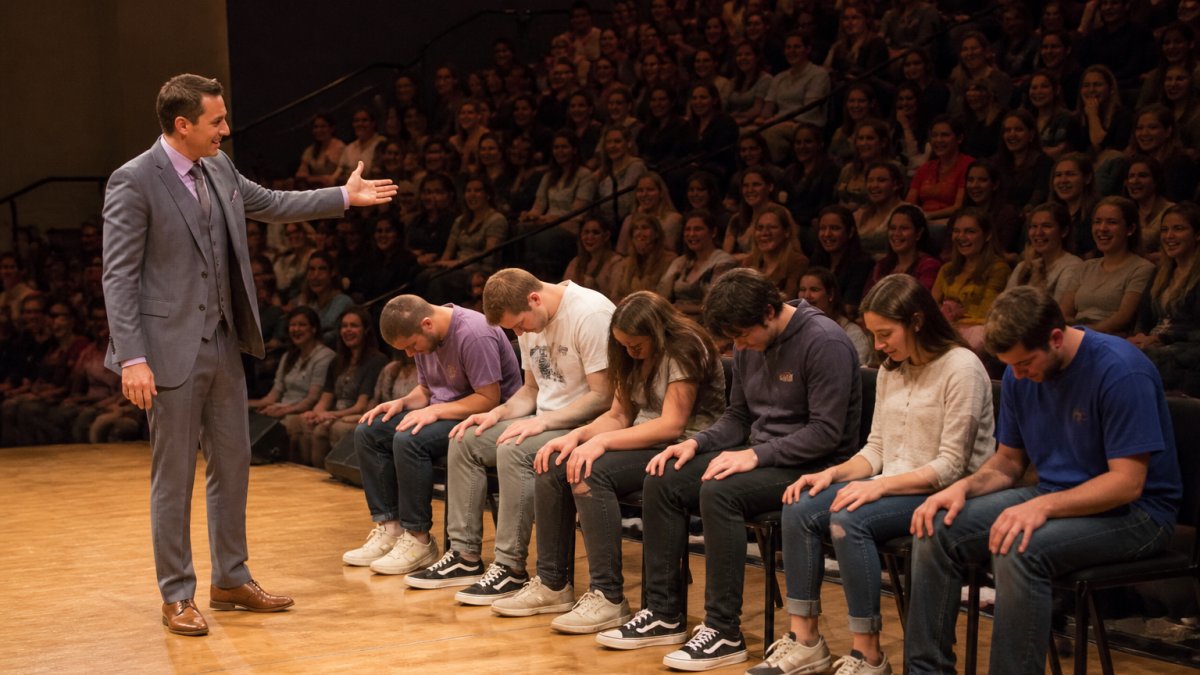
A performer gestures toward student volunteers on stage during one of our interactive stage shows for college audiences.

The structure rarely changes. The host opens with comedy and audience warm-up, then calls for volunteers.

What makes a college hypnosis show work is restraint.

A common mistake is assuming the whole crowd gets hypnotized. Most students simply watch and laugh.

Inside a College Mentalist Show: Reading the Room

A college mentalist show trades volunteers for mystery. The performer appears to read minds, predict choices, and reveal hidden details, all while students participate from their seats.

The format suits larger crowds because no one has to leave their seat.

Why it lands on campus:

  • Low barrier to entry: Students participate from the audience.
  • Universal appeal: Mystery works across majors and personalities.
  • Conversation starter: The “how did he do that” debate lasts for days.

A college mentalist show pairs well with a hypnosis act for a longer program. The mentalism warms the crowd, and the hypnosis closes with bigger laughs.

Your College Show Booking Checklist

Booking a campus performance is a logistics job, not a talent search. Most of the work happens before the performer loads in, and smooth-running schools treat the process as a sequence of approvals rather than a single purchase. This college show booking checklist keeps it on track from first email to final curtain.

Step What to Do Timing
1. Define the goal Set attendance, engagement, and budget targets; identify which office owns the event 4-6 months out
2. Check the calendar Confirm date against exams, breaks, home games, and rival events 4-6 months out
3. Confirm funding Route the fee through student activity fees, programming board funds, or departmental budgets 3-5 months out
4. Vet the performer Review full-length live footage, not just a highlight reel; call two references 3-4 months out
5. Request the rider Get the technical and hospitality rider in writing before you commit to a venue 3-4 months out
6. Confirm the venue Check stage dimensions, ceiling height, power, lighting, and load-in access against the rider 2-3 months out
7. Sign the contract Lock deposit, cancellation terms, force majeure, and backup plan 2-3 months out
8. Book campus logistics Reserve parking, security, custodial, and AV staff through the appropriate offices 6-8 weeks out
9. Promote the show Book social posts, flyers, tabling, and student org partners 4-6 weeks out
10. Run the day Assign a student liaison and a tech contact; do a walk-through before doors Event week

The Rider Is Where Bookings Break

The technical rider lists what the show needs: stage size, sound inputs, lighting states, microphone types, and sometimes a piano or specific sightline. The hospitality rider covers dressing room, water, parking, and meals.

Book A Show →

A common pattern is a venue that looks large enough on a tour but has a low ceiling or shallow stage, ruling out certain staging. Read the rider against the actual room before you sign, not after.

Questions to Ask Before You Sign

The contract matters as much as the show. Ask these before you commit:

  • What happens if the performer gets sick or cannot travel? Is there a written backup plan or a substitution clause?
  • What is the cancellation policy on both sides, and what deposit is refundable?
  • Does the contract include a force majeure clause covering weather, illness, and campus emergencies?
Watch Out
Skipping the backup-plan and force majeure questions is the most common booking mistake. A performer who falls ill the week of your event without a written contingency leaves you with a dark stage and a full auditorium. Get the answer in writing before you sign.

Campus Approvals Most Planners Forget

A signed performer contract is not the end of the approval chain. Most campuses require separate sign-offs on their own timelines: student activities for funding, facilities for venue use, campus security for crowd management, and risk management for insurance and waivers.

A student liaison who knows the campus approval map is worth more than a bigger marketing budget. Assign one early.

Budgeting, Logistics, and Keeping Participation Voluntary

Pricing for campus entertainment depends on the date, venue, travel distance, and program length. We quote each event individually, so ask for a current quote rather than working from a generic number. What you can do now is build a budget framework that holds up when the quote arrives.

A Budget Framework You Can Defend

Most campus programming boards approve a total event cost, not just a performer fee. Build the budget around these lines so nothing surprises the finance office:

  • Performance fee: The core cost, quoted per event. This is the number performers publish and the number most planners anchor on.
  • Travel and lodging: Often separate for out-of-area bookings. Ask whether travel is billed at a flat rate or reimbursed at cost, because the two behave very differently when flights move.
  • Per diem and ground transport: Meals, airport transfers, and local mileage. Small line items that add up on multi-day trips.

A useful trade-off to understand: a lower fee often means a performer who travels with less production support, which shifts more technical work onto your venue staff. A higher fee may include a fuller rider and a smoother load-in. Compare total event cost, not sticker price.

Logistics That Decide the Night

Confirm stage dimensions, ceiling height, power access, and load-in doors early, and match them against the rider. Assign one student liaison to meet the performer and one tech contact for lighting and sound.

Parking and security are the two most commonly forgotten logistics. A performer arriving with a vehicle needs a reserved space near the load-in door, and a crowded auditorium needs a crowd-management plan that campus security has signed off on. Book both through the appropriate office weeks ahead.

Keeping Participation Voluntary

Participation must stay voluntary, always. A tasteful show never pressures a student to volunteer. The host explains what will happen, invites hands, and respects every no.

A strong host explains the process before the call for volunteers, offers a clear way to decline without drawing attention, and checks in with each volunteer during the bit. If a student freezes or wants out, the host has a graceful exit ready and never makes the student feel foolish.

Key Takeaway
The strongest safeguard for audience participation is a performer who explains the process up front and gives students a clear, comfortable way to decline. Consent is not a formality. It is what makes the show work.

Accessibility belongs in the plan too. Reserve seating for students with mobility needs, provide captioning or a sign language interpreter when requested, and keep aisles clear. Build those requests into the venue booking, not the week of the event, because interpreter and captioning services often need lead time.

How to Measure Whether the Show Landed

You will know within a week whether the show worked. The signals are hard to miss.

Track these measures:

  • Attendance: Compare turnstile count to your target.
  • Volunteer rate: How many students raised a hand?
  • Post-event chatter: Social mentions, group chats, and word of mouth.

A show that lands produces conversation. Students quote bits, tag each other in photos, and tell friends who skipped it that they missed out.

For a fuller picture, pair the survey with a quick debrief from your student org partners. They hear the hallway talk you do not.

Frequently Asked Questions

What makes a stage show interactive for a college audience?

A show is interactive when students on stage and in the seats shape what happens next. That usually means volunteers pulled from the crowd, moments where the whole room responds, and material that references campus life. Interactive stage shows for colleges work because the audience is not watching a scripted play; they are part of the outcome. Ask a performer how many points of participation exist in a typical 45-minute set before you book.

How do we keep audience participation comfortable and voluntary?

Build consent into the plan, not the performance. Use sign-up sheets or a raised hand for volunteers, never pressure anyone from the aisle, and brief your student leaders on how to step in if someone freezes. A college mentalist show can run entirely with seated volunteers and no physical contact. Confirm with the performer that anyone can leave the stage at any time and that no one is singled out for embarrassment.

What should colleges ask a performer before booking a show?

Walk through a college show booking checklist: proof of insurance, a cancellation and backup plan, technical requirements for lighting and sound, show length, content boundaries, and references from similar campus events. Ask what happens if a volunteer becomes uncomfortable and how the performer handles a crowd that gets loud. Get the answers in writing so your activities office and administration can sign off without surprises.

How long should an interactive college stage show be?

Most campus shows land between 45 and 60 minutes, which fits an assembly block or an evening event without losing the room. Orientation programs often prefer 30 to 45 minutes because students are moving between sessions. Tell the performer your slot and ask whether they can scale up or down. A college hypnosis show that runs long tends to lose energy near the end, so match the length to your schedule rather than the other way around.


Planning a campus event means balancing budget, logistics, and a crowd that has seen everything. Dusty Satterlee brings 15 years of stage experience, training under veteran international stage hypnotist Michael C. Anthony, and membership in Stage Hypnosis University to every performance. The result is a tasteful, elegant show built to fill seats and start conversations. Book a show with Dusty Satterlee and give your students a night they will still be talking about at commencement.

Last Updated: October 28, 2026

Quick Summary

To evaluate performer videos, score each clip on a five-part rubric covering command of room, audience reaction, material fit, technical clarity and consistency, rating each category 1 to 5 for a total out of 25. Use at least two unedited clips per performer and confirm the footage comes from a crowd like yours.

  • A performance video is recorded evidence of craft, not proof of chemistry with your specific crowd.
  • Look for unbroken takes, wide shots showing the audience, and live unpolished sound.
  • A total of 20-25 signals a strong candidate; below 10 means pass.
  • Never let a high technical-clarity score rescue a low command-of-room score.
  • If two reviewers differ by more than 5 points, rewatch the clips together and reconcile.

Table of Contents

Why a Performance Video Is Not the Same as a Live Show

When you evaluate performer videos, remember a performance video is a recorded sample of an act, not a live show. A camera changes what an audience sees, and editing changes what a planner hears, that gap is where booking mistakes happen.

Treat a video as evidence, not proof: it shows craft, not chemistry with your specific crowd.

What to Look for in a Performance Video

Watch for command of the room, real audience reactions, and clean audio before you judge the act itself.

Three signals matter most:

  • Unbroken takes. A long, single-shot clip shows the performer without edits.
  • Wide shots. You need to see the audience, not just the stage.
  • Live sound. Crowd noise and reactions should be audible and unpolished.

A sizzle reel is one kind of footage to consider. Ask for raw footage from a real event as well.

Stage Presence and Command of the Room

Command of the room is the ability to hold attention. Watch how the performer moves, pauses, and fills silence.

Look for these cues:

  • The performer stands grounded, not pacing nervously.
  • Pauses land, and the crowd leans in during them.
  • The performer recovers fast when a bit doesn’t land.

Audience Interaction and Genuine Reactions

Watch the crowd, not just the stage.

Scan for these signs:

  • People reacting at different times, not in unison.
  • Volunteers who look relaxed, not coached.
  • Reactions that build, rather than one flat chuckle.

If every reaction looks identical, ask for footage from a different event to compare.

Separating Recording Quality From Performer Skill

A performer’s skill and a video’s production quality are two different things. A phone recording and a cinema-camera recording can differ in production quality.

A polished multi-camera edit does not, by itself, show how the act plays to a live room.

Use this filter instead:

  • Mute the video and watch body language.
  • Listen with your eyes closed and judge timing.
  • Watch a wide shot to read the crowd.

A Practical Rubric for Scoring Performer Videos

When you evaluate performer videos, you can score each on a five-part rubric, rating each category 1 to 5 and totaling the score.

Event planner using a laptop to evaluate performer videos while noting scores on a printed rubric sheet

Here is the rubric we recommend:

Category What to Score Weight
Command of room Holds attention, controls pace High
Audience reaction Genuine, varied, building High
Material fit Tasteful, matches your crowd High
Technical clarity Audio and wide shots usable Medium
Consistency Multiple clips show same quality Medium

A few rules keep the rubric honest: score only what you can see, use at least two clips per performer, and have a second reviewer score the same videos to catch bias.

How to Score Each Category

Use these anchors to guide reviewers’ scores.

Command of room (high weight)

  • 1: Performer reads as nervous or distracted; pacing stumbles; long dead spots go unfilled.
  • 2: Some control, but the performer loses the room at least once and does not recover quickly.
  • 3: Steady presence; holds attention in stretches but not consistently across the clip.
  • 4: Strong control; pauses land, pace shifts are deliberate, recovery from a missed beat is quick.
  • 5: Commands the room from the first 30 seconds; owns silence; adjusts pace to the crowd in real time.

Audience reaction (high weight)

  • 1: No visible reaction, or reactions look staged and uniform.
  • 2: Scattered reaction; laughter or applause arrives late or flat.
  • 3: Clear reaction in places, but it does not build across the clip.
  • 4: Varied, building reactions; different parts of the crowd respond at different moments.
  • 5: Reactions escalate through the clip; volunteers look genuinely at ease; the crowd visibly leans in.

Material fit (high weight)

  • 1: Material clashes with your audience, venue, or event tone.
  • 2: Mostly off-target; a few usable moments.
  • 3: Neutral fit; nothing offensive, nothing memorable.
  • 4: Well matched to your crowd type and event purpose.
  • 5: Written for a crowd like yours; references, pacing, and tone all land.

Technical clarity (medium weight)

  • 1: Audio unintelligible or no wide shot; cannot judge the act.
  • 2: Audio or framing problems obscure key moments.
  • 3: Usable but rough; some moments are hard to read.
  • 4: Clean audio and at least one wide shot that shows the crowd.
  • 5: Clear audio, wide and tight shots, and crowd visible throughout.

Consistency (medium weight)

  • 1: Only one clip, or clips contradict each other.
  • 2: Two clips, but quality varies sharply between them.
  • 3: Two clips of similar quality; no third data point.
  • 4: Three or more clips from different events show the same strengths.
  • 5: Multiple clips across audience types and venues all hold up.

Turning Scores Into a Decision

Add the five category scores for a total out of 25.

Book A Show →

  • 20-25: Strong candidate; move to references and contract questions.
  • 15-19: Viable with caveats; ask for additional footage from a crowd like yours.
  • 10-14: Weak fit; keep only if the act fills a specific slot no one else can.
  • Below 10: Pass.

Two rules can guide how you use the total. Never let a high technical-clarity score rescue a low command-of-room score. If two reviewers differ by more than 5 points on the same performer, rewatch the clips together and reconcile the anchors before comparing that performer to anyone else.

Pro Tip
Print the anchors and keep them beside the scoring sheet. Reviewers who score from memory drift toward the middle of the scale, which flattens the differences between a strong act and a weak one.

Documenting What You Saw

For each performer, note the timestamp of the moment that drove each score, e.g. “2:14, pause before the reveal; crowd silent, then laughed.” Timestamped notes can help a second reviewer check your reasoning and give you language for a reference call.

Keep one page per performer: the five scores, the total, two or three timestamped notes, and the clip source.

Evaluating by Performance Type and Audience Level

Consider the performance type and audience level when evaluating a video.

Consider these pairings:

  • High school assemblies: tasteful, inclusive material matters most.
  • College events: sharper humor and faster pacing tend to land.
  • Corporate functions: clean, professional tone with broad appeal.

Ask for footage from a crowd like yours. If they can’t show a similar audience, you can ask for more information.

What Changes by Performance Type

The five rubric categories stay the same. Judge each video against criteria relevant to its type.

Dance

  • Technique: line, extension, and control hold up in a wide shot, not just a tight edit.
  • Timing: group choreography stays synchronized through the full clip.
  • Stamina: compare the performer’s energy in the last minute with the first.
  • Floor and spacing: the act fits the stage size you have, not just the one in the video.

Music

  • Live audio: listen for vocals and instruments, and note whether a studio track is used over live footage.
  • Crowd read: observe whether the performer watches the room between songs.
  • Set pacing: energy rises and falls deliberately rather than sitting at one level.
  • Technical needs: note whether the clip shows the setup.

Acting and character work

  • Reactivity: the performer responds to a scene partner, not just delivers lines.
  • Physical control: gestures and blocking read from the back of a room.
  • Material range: compare clips that show different tones.

Public speaking and keynote

  • Structure: note whether the clip shows a complete arc or only the applause line.
  • Audience engagement: observe audience responses to questions, pauses, and callbacks.
  • Slide and prop dependence: note how the talk uses visuals.

Comedy and variety

  • Recovery: note whether the clip shows a moment that did not land and how the performer handled it.
  • Crowd work: observe volunteers’ reactions and whether audience responses vary.
  • Material fit: consider whether references suit the audience type.

What Changes by Audience Level

Audience level involves more than age; consider the audience and event context when evaluating a performance.

  • School and youth audiences: material review matters most; ask for the exact clip shown to a similar age group, and confirm the performer has a clean-material version.
  • College and young adult: faster pacing and sharper material tend to land, but the act still needs a recovery plan for a flat room.
  • Corporate and association: broad appeal and a professional tone carry more weight than edge; check whether the performer has worked a seated dinner versus a standing reception.
  • Community and family: mixed ages in one room; look for footage where the performer holds both older and younger attendees at once.

The Cross-Check That Catches Mismatches

Before you score, ask whether the clip comes from a crowd like yours. If it does not, consider waiting to score material fit until you see footage from a comparable audience.

Watch Out
If a performer cannot provide footage from a similar audience, ask for a reference from an event like yours before you sign.

Questions to Ask Before Booking a Performer

Ask about footage, audience fit, and backup plans before you sign anything.

Start with these:

  • Can you send unedited footage from an event like ours?
  • How do you adjust material for our audience?
  • What happens if you can’t perform on the day?
  • Do you carry your own sound and lighting needs?
  • Can you share references from similar events?

Your Performer Booking Checklist

Use this performer booking checklist to move from shortlist to signed contract.

  • Watched at least two unedited clips
  • Scored each performer on the five-part rubric
  • Confirmed footage matches your audience type
  • Asked about backup and cancellation terms
  • Checked references from similar events
  • Reviewed material for taste and fit
  • Confirmed technical needs and setup time
  • Signed a contract with clear terms

Work through the checklist in order.

Book a Show That Matches What You Saw on Screen

Score the footage, consider how it relates to your crowd, and ask questions before booking.

Dusty Satterlee offers comedy stage hypnosis and mentalism performances in a tasteful and elegant style. Dusty has over 15 years of experience, was trained by veteran international stage hypnotist Michael C. Anthony, and is a member of Stage Hypnosis University.

When you’re ready to book a show, get started with Dusty Satterlee.

Frequently Asked Questions

What should you look for in a performer’s video?

Focus on four things: how the performer holds the room, how the audience reacts, whether the material fits your event type, and whether the footage looks edited to hide weak moments. Watch for unbroken crowd shots where people are visibly engaged rather than polite. Compare clips of different lengths and note the audience’s reactions. Ask for full-length footage from a comparable event, not just a highlight reel.

How can you tell whether a performance video is representative?

Check the setting, crowd size, and event type in the footage. Consider whether the footage’s setting, crowd size, and event type are relevant to your event. Ask what event the clip came from, when it was recorded, and whether it was edited. Request a raw or minimally edited clip and compare it to the polished reel. If the performer cannot supply unedited footage, consider what the highlight reel does and does not show.

How do you assess a performer’s professionalism from a video?

Look at things beyond the jokes: whether the performer arrives prepared, how they handle a flat moment, and whether the material stays appropriate for the audience. Watch for how they treat volunteers and whether anyone looks uncomfortable. Then confirm the off-screen details with a few direct questions about insurance, cancellation policy, and backup plans. Clear answers can help you understand the performer’s arrangements.

What questions should you ask before booking a performer?

Ask which event the footage came from and whether it was edited. Run through your performer booking checklist before signing anything.

Last Updated: October 26, 2026

Quick Summary

Interactive entertainment is live programming that asks the audience to take part rather than just watch, and the best formats for corporate retreats are hosted game shows, audience-participation performances, hands-on workshops, and close-up mentalism. Match the format to your group size and retreat goal, then plan setup and transitions.

  • Hosted game shows suit groups of 30 to 300 and run 45 to 90 minutes.
  • Groups of 100 to 200 are the hardest to program and need strong audience participation.
  • For a 60-minute hosted show, budget about 30 minutes for setup and 10 for a sound check.
  • Book four to six months out for peak dates and large groups.
  • Ask for an all-in number that includes travel, lodging, equipment rental, and venue AV charges.

Table of Contents

Why Interactive Entertainment Belongs on Your Retreat Agenda

Format matters more than budget. A retreat should mix people who rarely talk, reward the team, and send everyone home with a shared story.

Dusty Satterlee has spent more than 15 years performing comedy stage hypnosis and mentalism for corporate groups, high schools, and colleges.

Below: the formats that work, how to match them to your group size and goals, and how to plan the run-of-show.

Corporate Retreat Entertainment Ideas That Get Everyone Involved

The strongest corporate retreat entertainment ideas share one trait: they turn the audience into participants. Here are the formats that work most often.

Hosted Game Shows and Team Competitions

A hosted game show puts staff in teams, gives them silly but fair challenges, and lets a host keep the pace tight. Trivia nights, custom quizzes, and relay-style competitions all fit.

Team-building activities work best when the rules are easy and the stakes are low. Cornhole, mini golf, foosball, and pickleball tournaments give people a reason to cheer for coworkers they barely know.

  • Best for: groups of 30 to 300
  • Time needed: 45 to 90 minutes
  • Why it works: built-in team competition and crowd participation

Live Performances With Audience Participation

Live music, a magic show, or a mentalism set can anchor an evening. The key word is participation. A performer who brings volunteers up front and reads the room creates a shared experience a DJ set cannot match.

Hands-On Workshops and Creative Sessions

Creative workshops, a hands-on cooking class, or a group art session give attendees something to do with their hands, suit smaller groups and quieter agendas, and produce something people can take home.

Corporate Team Building Activities That Fit Your Group Size

Group size should drive your choice more than anything else: a format that sings with 40 people can fall apart with 400.

Group Size Best Formats Room and Logistics Notes Watch Out For
Under 50 Workshops, close-up mentalism, cooking classes, escape-room-style puzzles One room with movable seating; a single facilitator can run the room Formats that need a big crowd to feel alive; stations that leave half the group idle
50 to 150 Hosted game shows, trivia, team tournaments, improv sessions Break into 6 to 12 teams; one central stage or focal point; a wireless mic per host Too many small stations with no central focus; long team-forming transitions
150 to 400 Stage shows, comedy hypnosis, audience-participation performances, large-scale trivia Stage at least 16 feet wide, clear sightlines, two handheld mics, a sound check before doors Slow volunteer selection; long setup times; splitting the room into too many pieces
400+ Full stage productions with a strong host, multi-round competitions with a scoreboard Professional AV, IMAG screens if the room is deep, a stage manager to run cues Anything that requires herding the whole room between spaces mid-program

Smaller groups often worry a headline performer is out of reach, but close-up mentalism scales down beautifully and a stage show scales up.

Groups of 100 to 200 are the hardest to program: too big for intimate formats, too small to feel like a stadium.

Match the Format to Participation Styles, Not Just Headcount

Headcount tells you what fits in the room; participation style tells you what fits the people. A retreat usually mixes eager volunteers, willing-but-shy attendees, and watchers from the back, build the agenda so all three have a good night.

  • Volunteer-forward formats (game shows, comedy hypnosis, improv) reward extroverts and give the room a shared story. Keep volunteer selection voluntary and give people an easy way to decline.
  • Observer-friendly formats (close-up mentalism during a reception, a headline stage show, live music) let quieter attendees participate by watching and reacting without being called up.
  • Hands-on formats (workshops, cooking classes, puzzle challenges) suit people who prefer a task to a spotlight and work well when the group includes mixed mobility or sensory needs.

A common pattern: pair one volunteer-forward centerpiece with one observer-friendly option earlier in the evening, giving extroverts their moment and everyone else a comfortable on-ramp.

Plan the Transitions, Not Just the Activity

The activity is the easy part; transitions are where schedules slip. For a 60-minute hosted show, budget about 30 minutes for setup, 10 for a sound check, and 5 to 10 for volunteers to reach the stage and back.

If your venue has a hard dinner service or a room flip, put the entertainment on one side of it. A show that has to pause for a catering change loses more energy than a show that starts 15 minutes later than planned.

Pro Tip
Walk the room before you book. Confirm sightlines from the back row, a clear path from the audience to the stage, and a power drop near the performance area. These three checks prevent most day-of surprises.

Mentalism for Corporate Events: Close-Up Wonder Without the Pressure

That matters at a retreat. Your people are already out of their comfort zones. Entertainment should reward them for showing up, not test their nerve.

Close-up mentalism works especially well during a cocktail hour or group dinner: small groups gather, the performer moves between them, and there is no stage, spotlight, or pressure.

  • Best for: cocktail hours, dinners, smaller groups
  • Vibe: elegant, curious, low-stress
  • Participation level: voluntary and light

A common mistake is booking mentalism as the main event for a huge crowd.

Book A Show →

Comedy Hypnosis for Corporate Events: A Tasteful, High-Energy Option

The word that matters is tasteful. Dusty Satterlee’s shows are built around willing volunteers and clean humor. Nobody is mocked, and nothing crosses a line.

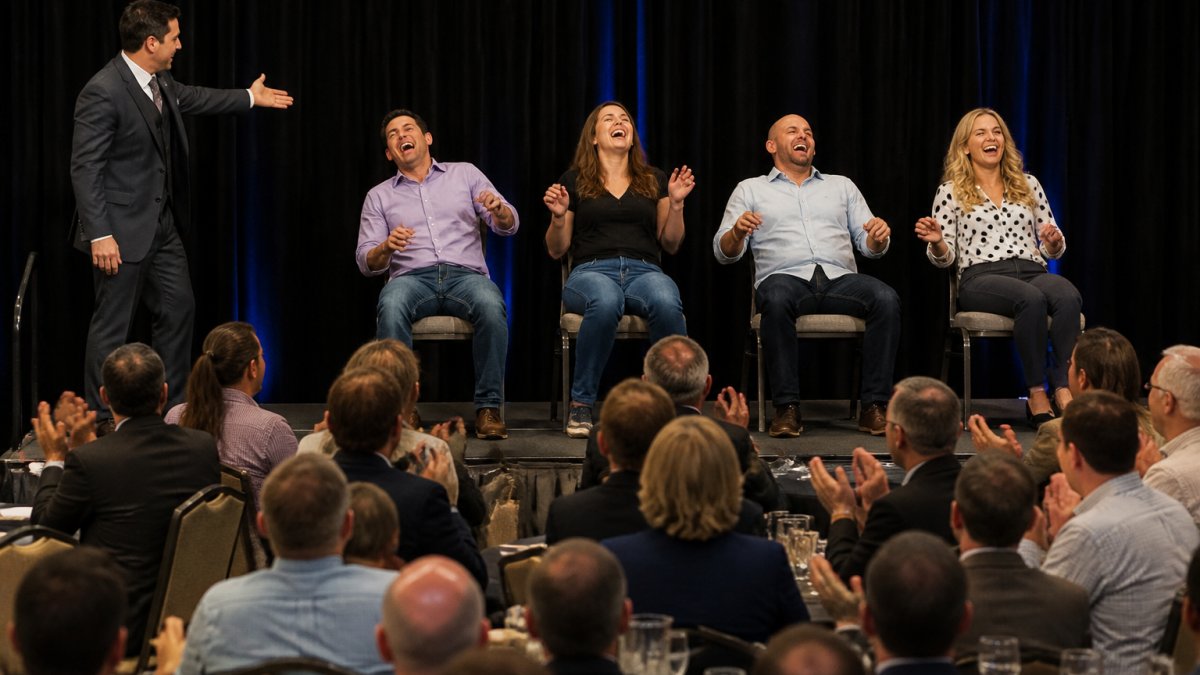
Stage hypnotist performing interactive entertainment for laughing volunteers at a corporate ballroom event

Watch out: hypnosis gets a bad reputation from performers who push volunteers too far. Ask any provider how they select volunteers and how they handle a guest who wants to stop.

Dusty’s training under veteran international stage hypnotist Michael C.

Matching Entertainment to Your Retreat Objectives and Run-of-Show

Start with the goal, then pick the format. That order saves money and prevents the classic mistake: booking a great act that has nothing to do with why you gathered.

  • Goal: break down silos. Choose team competitions and hosted game shows.
  • Goal: reward the team. Choose a headline stage show or live performance.
  • Goal: spark creativity. Choose workshops and hands-on sessions.

Then build the run-of-show: a clear slot, a sound check, and a stage or floor plan.

Weather-proof your plan too. Outdoor activities like a scavenger hunt, hiking, or horseback riding are great until it rains. Keep an indoor backup ready.

Budgeting, Accessibility, and Measuring Whether It Worked

Most retreat guides stop at the idea. Planners get burned when they never priced it, never checked whether the room worked for every guest, and never agreed on what success looks like. This section closes that gap.

Budget: Know the Cost Drivers Before You Ask for a Quote

Pricing depends on the format, group size, date, and travel, so ask for a quote rather than guessing. But you can qualify options before the first call by understanding what moves the number.

  • Format and duration. A workshop or close-up set generally costs less than a full stage production with AV and a larger crew. A 45-minute set and a 90-minute set are different products.
  • Group size and room count. Large groups may need bigger sound, more mics, or a second performer for breakout rooms. Ask whether the quote covers one room or several.
  • Travel and lodging. Out-of-town performers usually quote travel, lodging, and per diem separately. Get those line items in writing so the total cost of ownership is clear.
Watch Out
Ask for an all-in number, not a performance fee. The all-in number should include travel, lodging, equipment rental, and any venue AV charges. Comparing performance fees across providers is the fastest way to pick the wrong option.

Accessibility and Inclusion: Build the Plan Before the Room Is Set

Accessibility deserves a real plan, not an afterthought: every guest should be able to see, hear, and take part at the level they choose.

  • Seating and sightlines. Reserve seats for guests who cannot stand for long periods, and confirm that the back row can see the stage or screen. For close-up formats, plan a seated option as well as a standing one.
  • Hearing and language. Confirm a microphone for the host, captions or a transcript for any recorded or streamed content, and a plan for guests who use American Sign Language interpreters. Share any written materials in advance.
  • Mobility and sensory needs. Check the path from seating to the stage, the location of restrooms, and whether the room has a quiet area guests can step into. Ask the performer how they adapt for different participation styles and whether they can lower the volume or lighting intensity.

Measuring Outcomes: Keep It Simple and Comparable

Measurement does not need a research budget. It needs a baseline and a follow-up. Pick two or three signals before the retreat and compare them to last year or to a pre-event survey.

  • Survey attendees the next day on energy and enjoyment, using the same questions you used last year so the numbers are comparable
  • Track how many volunteered versus watched, and note whether the split matched your plan
  • Note how many people mention the show in follow-up chats, Slack channels, or the next all-hands

The signals are usually obvious. If people are still quoting the show at lunch the next day, it worked. If the room was quiet and the volunteers were the same five people, the format or the on-ramp needs adjusting next time.

Key Takeaway
Budget, accessibility, and measurement are the three places where a retreat entertainment plan either holds up or falls apart. Get the all-in number, build the inclusion plan, and pick your success signals before the event, not after.

Booking Interactive Entertainment for Your Next Retreat

Book early, ask the right questions, and lock the details in writing. Those three habits separate a smooth retreat from a stressful one.

Here is what we tell every planner who calls:

  • Book four to six months out for peak dates and large groups.
  • Ask for recent video of a full show, not just a highlight reel.
  • Confirm the backup plan if the performer gets sick.

At Dusty Satterlee, a blend of world-class mentalism and comedy stage hypnosis is brought to every booking.

You can check availability and request a quote through our booking page. Tell us your date, group size, and goal, and we will recommend the format that fits.

Frequently Asked Questions

What are some interactive entertainment ideas for corporate retreats?

Hosted game shows, team competitions like cornhole or mini golf, live music with crowd participation, mentalism performances, comedy hypnosis, creative workshops, and photo or video activations all work well. The right pick depends on your agenda, group size, and whether you want people competing, creating, or simply watching. Mix one high-energy anchor activity with lighter options so different personality types have something to enjoy.

How long should entertainment at a corporate retreat last?

Most retreat entertainment works best in blocks of 30 to 60 minutes. A comedy hypnosis or mentalism show typically runs 45 to 60 minutes, while game shows and workshops can stretch to 90 minutes with breaks. Place the main entertainment after dinner or at the end of a strategy session, when energy tends to dip, and keep a shorter activity in reserve for the following morning.

How do you choose entertainment that works for different personality types?

Offer a mix of participation levels. Not everyone wants to be on stage, so pair a volunteer-driven show with passive options like a photo activation or audio guestbook. For corporate team building activities, use small-group formats where people can contribute without being singled out. Tell the entertainer your group’s culture in advance so they can dial audience involvement up or down.

Is comedy hypnosis appropriate for a corporate audience?

A professional stage hypnotist keeps the material tasteful and avoids anything that could embarrass a volunteer or clash with company culture. Ask about content style and audience screening before booking, and confirm the performer carries insurance and has worked with corporate groups. Dusty Satterlee’s performance style is built around elegant, tasteful participation, which suits retreats where colleagues and managers share a room.


Your retreat deserves entertainment people talk about on Monday, not forget by lunch. Dusty Satterlee offers a tasteful, high-energy blend of comedy hypnosis and mentalism, backed by 15 years of stage experience and training under veteran performers. Get started with Dusty Satterlee and give your team a night they will remember.

Last Updated: October 25, 2026

Quick Summary

Booking comedy hypnosis for fundraisers means hiring a trained stage hypnotist who guides willing volunteers into a relaxed, focused state and leads them through funny, harmless scenarios for the audience. Ask about experience, insurance, and cancellation terms, then request a written quote for your date and venue.

  • A comedy hypnosis show typically runs 45 to 60 minutes for a fundraiser.
  • Break-even equals total show cost divided by your average ticket price.
  • Place the show before your final ask so a laughing crowd gives generously.
  • Confirm a stage at least 12 feet wide and 8 feet deep with 8 to 12 volunteer chairs.
  • Get insurance, cancellation, and backup terms in writing before you sign.

Table of Contents

Why Comedy Hypnosis Fills Seats and Raises More Money

Booking comedy hypnosis for fundraisers works because it turns your audience from spectators into the show.

Here is the honest math of a fundraising event: every empty chair is lost revenue. Silent auctions and raffles only work when people stay long enough to bid.

At Dusty Satterlee, we have spent more than 15 years building shows that do this quietly and tastefully. No mean-spirited gags, no one humiliated.

Questions to Ask a Hypnotist Before Booking

Before you sign anything, ask a short list of questions that separate a professional from a hobbyist. A real stage hypnotist will welcome every one of them.

  • How long have you performed, and what training or credentials back that up?
  • What is your show length, and can you adapt it to our schedule?
  • Is your material clean and family-friendly for our audience?
  • How do you choose and protect volunteers?
  • Are you insured, and what does your contract say about cancellations?
  • What are your technical and venue requirements?
  • Can you provide references from fundraisers or schools?

The questions to ask a hypnotist before booking come down to safety, experience, and fit. Ask for references and actually call one. Ask what happens if the performer gets sick on event week.

Watch out: skipping the insurance and cancellation questions is the most common mistake fundraising committees make.

What Comedy Hypnotist Cost Looks Like for a Fundraiser Budget

Comedy hypnotist cost depends on the length of the show, the date, travel, and the size of your event. There is no single national rate, and any performer who quotes you a flat number before asking about your venue and audience is guessing.

Most fundraising committees find it more useful to plan around a break-even target than around a headline fee. The worksheet below is the one we walk committees through before we quote.

Budget Line What It Covers Planning Note
Performance fee The show itself Ask for a quote based on show length and date; confirm whether travel is bundled
Travel Performer getting to your venue Confirm whether travel is included or billed separately, and whether it is capped
Venue and tech Stage, sound, lighting, chairs Often already in your venue contract, confirm before you pay twice
Promotion Tickets, signage, social posts Budget a small line for printing and boosted posts
Contingency Backup plans and deposits Set aside a margin for changes and a deposit you may not recover

How to Set a Break-Even Target

Break-even is simple arithmetic: total show cost divided by your average ticket price equals the number of paid seats the show must fill to pay for itself. If your all-in show cost is $3,000 and your average ticket is $75, you need 40 paid seats before the show contributes a dollar to the cause. Every seat above 40 is fundraising revenue.

Run the same math three ways, conservative, expected, and stretch, using your venue’s real capacity. A 200-seat room at a $75 average ticket grosses $15,000 before expenses; the same room at a $40 average ticket grosses $8,000. The show fee is identical in both scenarios, which is why ticket pricing and capacity matter more to your net than shaving a few hundred dollars off the performer’s fee.

Three Ways Committees Cover the Fee Before Doors Open

  1. A show sponsor. Ask a local business to underwrite the performance fee in exchange for logo placement on the stage, program, and ticket page. A single sponsor at the fee amount turns the show into a zero-cost line item.
  2. A tiered ticket. Price a VIP or front-row table that includes a meet-and-greet or reserved seating. The premium tier often covers the fee on its own.
  3. Advance sales. Pre-sell tickets through a simple online page and set a goal of covering the fee in pre-sales. Once the fee is covered, every door sale is net revenue.

Ask every performer you contact for a written quote that itemizes fee, travel, and any tech or lodging charges. A quote you can put in a committee packet is worth more than a phone number, because your board will ask for it.

When you request a quote, ask whether the fee includes travel, how deposits work, and what the payment schedule looks like. Clear answers up front prevent surprises later, and they let you plug real numbers into the break-even worksheet above.

Comedy Hypnosis Show Length and How to Build Your Run of Show

A comedy hypnosis show typically runs 45 to 60 minutes for a fundraiser, though many performers offer a longer headline set and shorter options for tight schedules. The right comedy hypnosis show length depends on what else is happening that night.

Build your run of show around the performance, not the other way around:

  1. Arrival and dinner service (60-90 minutes)
  2. Brief welcome and fundraising appeal (10 minutes)
  3. Comedy hypnosis show (45-60 minutes)
  4. Volunteer release and thank-yous (10 minutes)
  5. Auction close or pledge collection (20 minutes)

Place the show before your final ask. Guests who have just laughed together are in a generous mood. Keep speeches short and put the entertainment where it can carry the room into the donation moment.

Book A Show →

Comedy Hypnosis Audience Participation That Feels Safe and Voluntary

Comedy hypnosis audience participation is always voluntary. A professional hypnotist invites volunteers from the audience and never forces anyone onto the stage.

Here is how good participation works in practice:

  • The performer explains what will happen before anyone comes up.
  • Volunteers raise their hands and choose to participate.
  • Anyone who wants to stop can step down at any point, no questions asked.
  • The material stays clean and never targets a volunteer’s appearance or identity.
A stage hypnotist guiding a small group of smiling volunteers seated in chairs on a brightly lit stage, with a packed fundraiser audience watching and laughing in the foreground

Ethical performance means the audience trusts the show. If your crowd includes students, families, or coworkers, confirm in advance that the material is family-friendly and that the performer has a plan for nervous volunteers.

Venue Setup, Technical Needs, and Contract Terms to Confirm

Venue and technical requirements are simple but easy to overlook. A stage hypnotist needs a clear performance area, good lighting on the stage, a working microphone and sound system, and enough room for chairs for volunteers. Confirm seating for your event audience and make sure the front of the room is visible from every table.

Venue and Tech Checklist

Walk your venue with this list before you finalize the booking, and send it to the performer so there are no event-week surprises.

  • Stage or performance area: a clear, flat space at least 12 feet wide and 8 feet deep, with room for 8 to 12 volunteer chairs.
  • Sound: a handheld or lavalier microphone and a sound system the performer can plug into, plus a backup mic if the venue has one.
  • Lighting: stage lighting bright enough to see faces from the back row, with a way to dim the house lights during the show.
  • Seating: sightlines from every table to the stage; avoid pillars or speaker stacks between the audience and the volunteers.
  • Accessibility: a step-free route to the stage and volunteer area, and seating that accommodates guests with mobility devices.
  • Green room: a quiet space where volunteers can sit before and after the show, away from the crowd.
  • Load-in: a door close to the stage, and a load-in window confirmed with the venue.

The most common event-night failure is a microphone that works during soundcheck and fails during the show. Ask the venue whether they have a backup mic and a technician on site, and confirm who is responsible for sound during the performance.

Contract Terms to Confirm in Writing

Read the contract line by line, and confirm these terms before you sign:

  • Insurance: ask for a certificate of liability insurance naming your organization and the venue as additional insured, and confirm the coverage limit meets the venue’s requirement.
  • Cancellation policy: what happens if either side cancels, how many days’ notice is required, and whether the deposit is refundable or applied to a rescheduled date.
  • Force majeure: whether severe weather, illness, or venue closure triggers a refund or a reschedule.
  • Backup plan: what the performer does if they fall ill on event week, a substitute performer, a recorded alternative, or a refund.
  • Travel and arrival: when the performer arrives, who covers travel and lodging, and whether travel is capped.
  • Payment schedule: deposit amount, final payment date, and accepted payment methods.
  • Exclusivity and recording: whether the show can be photographed or recorded, and who owns the footage.

Watch out: a contract with no cancellation clause protects the performer, not you. Get the cancellation and backup terms in writing so your committee is never caught without a plan. If the venue requires a certificate of insurance, request it at signing rather than the week of the event, some performers need a few business days to have their insurer issue one.

Tie the Contract to Your Run of Show

Put the load-in, soundcheck, and show times in the contract so the venue and the performer are working from the same schedule. A typical fundraiser contract confirms a load-in window 90 to 120 minutes before doors, a soundcheck before guests arrive, and a show start time that matches your printed program. When those three times are in writing, your committee can build the rest of the night around them with confidence.

Book Your Fundraiser Show With Dusty Satterlee

Booking comedy hypnosis for fundraisers gets a lot easier when you work with a performer who has done it many times.

Our clients keep coming back for a reason. One school organizer told us the team was prompt and that students and volunteers at their post-prom event really enjoyed the show.

When you are ready, request a quote for your date and venue.

Frequently Asked Questions

How do you book a comedy hypnotist for a fundraiser?

Start by defining your date, venue, audience size, and budget, then reach out to performers directly through their booking page with those details. Ask for a quote, confirm availability, and request a written contract covering show length, travel, technical needs, and cancellation terms. Book four to six months ahead for peak fundraising seasons, and ask for references from similar events before you sign.

How much does comedy hypnotist cost for a fundraising event?

Comedy hypnotist cost depends on the performer’s experience, your location, travel distance, show length, and the date. Fundraisers often negotiate a flat fee or a reduced rate in exchange for promotion, and some performers work with a portion tied to ticket sales. Request a written quote that itemizes travel and any add-ons so you can compare offers fairly and build the fee into your revenue plan.

Is comedy hypnosis appropriate for a school or community fundraiser?

Yes, when you hire a performer who advertises clean, family-friendly comedy and can describe how they keep volunteers comfortable on stage. Ask about their audience participation policy, how they handle a volunteer who wants to stop, and whether they carry insurance. A tasteful show keeps the focus on laughter and keeps your donors, students, and parents coming back next year.

How far in advance should you book entertainment for a fundraiser?

Book three to six months ahead for most fundraisers, and earlier if your date falls in a busy season like spring or the winter holidays. Popular comedy hypnosis performers fill weekend dates quickly. Booking early also gives your committee time to lock the venue, print tickets, and promote the show, which matters more for turnout than almost any other planning step.


Your fundraiser deserves entertainment that fills seats and gets people talking. Dusty Satterlee offers a combination of world-class mentalism and hypnosis, a tasteful and elegant performance style, and the experience to read a room and keep it laughing. Get started with Dusty Satterlee and book a show your guests will remember long after the last volunteer leaves the stage.

Last Updated: October 23, 2026

Quick Summary

Booking mentalists for company events means hiring a professional entertainer who performs mind-reading-style demonstrations, predictions, and interactive experiments for business audiences. Most corporate bookings are confirmed 30 to 60 days in advance, and the process runs from defining the slot and setting a budget through shortlisting performers, requesting an itemized quote, and confirming logistics two weeks out.

  • A stage show fills a general session slot, while close-up mentalism works receptions and dinners without a stage.
  • Corporate mentalist cost depends on show length, number of performers, travel, date, customization, and audience size.
  • Ask for recent unedited performance footage rather than a highlight reel before you sign.
  • Confirm load-in timing, microphones, and sightlines in writing two weeks before the event.
  • Read cancellation, rescheduling, substitution, and payment terms closely before signing the contract.

Table of Contents

Why Mentalists Work for Company Events

Booking mentalists for company events solves a problem most planners face around the third hour of a corporate gathering: the room goes quiet and the phones come out.

At Dusty Satterlee, we’ve spent more than 15 years watching audiences move from polite applause to genuine disbelief, and the pattern holds across ballrooms, auditoriums, and retreat halls.

The format also fits the way corporate events actually run.

What a Corporate Mentalist Actually Does

A corporate mentalist is a professional entertainer who performs mind-reading-style demonstrations, predictions, and interactive experiments for business audiences, typically blending stage presence with audience participation. The work is scripted, rehearsed, and built for a specific room and a specific crowd.

The performance usually includes a few recognizable elements:

  • Predictions sealed before the show and opened by a guest on stage
  • Audience members choosing words, numbers, or objects the performer then reveals
  • Psychological demonstrations that explain how suggestion shapes decisions

What separates a strong corporate mentalist from a party trick is calibration. The material gets adjusted for the audience: a sales retreat gets sharper competitive framing, a student assembly gets cleaner humor, and a formal dinner gets a quieter, more elegant pace.

Events That Fit Mentalism Best

Corporate events, conferences, trade shows, retreats, and corporate dinners are the strongest fits for mentalism, because each one has a seated or gathered audience that needs a shared focal point.

Here’s how the fit breaks down by event type:

Event Type Best Format Why It Fits
Conferences and conventions 30-45 minute stage show Gives a general session a memorable close
Trade shows Close-up or booth work Pulls foot traffic and starts conversations
Company retreats Evening stage show Builds shared experience across departments
Corporate dinners Close-up table work Keeps energy up between courses
Student assemblies Full stage show Holds a large, restless audience

Conventions and conferences benefit most from a stage show placed before a keynote or at the end of a long day.

A corporate audience in a hotel ballroom laughing and leaning forward as a mentalist on stage holds up a sealed envelope, with guests seated at round tables in the foreground

Corporate Event Entertainment Ideas Beyond the Stage Show

Corporate event entertainment ideas that work rarely stop at one performance. The strongest programs pair a main stage act with smaller interactive moments, so the energy carries through the whole evening instead of peaking for 40 minutes and dying.

Consider these combinations:

  • Stage show plus close-up: a headline performance followed by table-by-table mentalism during dinner
  • Interactive magic during cocktails: short, walk-around sets that break the ice before seating
  • Audience-participation segments: guests invited on stage for a single experiment, which gives the room a story to retell

Guest interaction is the thread connecting all of these. When people are on their feet, talking to each other, and comparing what they just saw, the event stops feeling like a scheduled obligation.

Pro Tip
The single highest-impact upgrade to a corporate entertainment budget is pairing a stage show with 30-45 minutes of close-up work during the reception. It costs less than adding a second headline act and keeps guests engaged during the exact window when they’d otherwise drift toward the bar.

What Corporate Mentalist Cost Really Depends On

Corporate mentalist cost depends on the length of the performance, the number of performers, travel distance, the date, and how much customization the act requires.

The variables that move the number most:

  • Show length and format: a 30-minute stage show and a two-hour close-up engagement are different products
  • Travel and event location: distance and overnight requirements add cost
  • Date and season: peak corporate seasons and holiday parties command higher fees

We don’t publish fixed rates, because a school assembly for 400 students and a formal corporate dinner are not the same booking. The most reliable approach is to request a quote with your date, venue, audience size, and preferred format in hand, then compare that quote against what each performer includes.

Watch Out
The most common budgeting mistake is comparing headline fees without comparing what’s included. A lower quote that excludes travel, sound support, or a second performer can cost more than a higher quote that bundles them. Ask for an itemized breakdown before you sign anything.

Questions to Ask a Corporate Entertainer Before You Sign

The questions to ask a corporate entertainer before signing fall into four groups: content suitability, audience fit, logistics, and contingency. Asking them early saves a painful conversation later.

Run through this checklist before any contract goes to signature:

  • Can you share recent, unedited performance footage rather than a highlight reel?
  • How do you adapt material for a mixed or conservative audience?
  • What technical requirements do you have, and who supplies them?

That first question matters more than any other. A highlight reel shows the best 90 seconds of a hundred shows.

The audience-suitability question deserves equal weight. If your student body or workforce is diverse, ask directly how the performer keeps comedy tasteful and avoids material that alienates part of the room.

Book A Show →

How to Compare Performers and Judge Real Quality

Comparing performers comes down to evidence, not impressions. Reviews, references, full-length footage, and a clear contract separate professional entertainers from people who market well and deliver inconsistently.

Judge on these signals:

  • Full-length footage over highlight reels. Anyone can cut 90 good seconds. Watch a full set to see pacing, audience handling, and how the performer recovers when a bit lands flat.
  • References from your event type. A performer who is excellent at comedy clubs may be wrong for a corporate audience.
  • Reviews that mention specifics. “Great show” tells you nothing. Reviews that name the format, the audience, and the outcome tell you a lot.

The thing nobody tells you about comparing acts is that the best ones will occasionally talk you out of a booking. If a performer tells you their show isn’t right for a seated awards dinner, that’s a strong signal they’ll be honest about everything else.

A Step-by-Step Booking Process for Booking Mentalists

Booking mentalists follows a predictable sequence, and starting early protects both your budget and your preferred date. Most corporate bookings are confirmed 30 to 60 days in advance, with larger conferences and holiday events often locked in earlier.

Here’s the process we recommend:

  1. Define the slot. Decide which part of the event needs entertainment, how long it should run, and whether guests will be seated or standing.
  2. Set a realistic budget range. Include travel and any technical support in the number, not just the headline fee.
  3. Shortlist three to five performers. Compare full-length footage and references from events like yours.
  4. Check availability for your preferred date. Ask about backup dates at the same time.
  5. Request a detailed quote. Ask for an itemized breakdown covering performance, travel, and equipment.
  6. Confirm the format and content. Agree on audience interaction level, tone, and any material to avoid.
  7. Sign the contract and pay the deposit. Get the cancellation and rescheduling terms in writing.
  8. Confirm logistics two weeks out. Reconfirm load-in time, room layout, sound, and a contact on site.

Last-minute bookings do happen, and some performers keep limited dates open. Availability shrinks fast in peak season, so if your date is fixed, start the conversation early.

Logistics, Tech, and Accessibility Checks

Logistics determine whether a great show lands or falls flat. Confirm the room layout, the sound setup, load-in access, and the timing of your other program items before the performer arrives.

Work through this list with your venue:

  • Room and staging: what the performer needs for a stage show versus close-up work
  • Sound: whether the venue supplies a microphone and operator, or the performer brings their own
  • Load-in and setup time: how early the performer needs access to the room

Accessibility deserves early attention rather than a last-minute fix. If guests use wheelchairs or have hearing or vision needs, tell the performer and the venue in advance so the format can adapt.

Key Takeaway
The booking details that cause the most day-of problems are almost never the performance itself. They’re load-in timing, missing microphones, and seating that blocks sightlines. Confirm those three items in writing two weeks before the event.

Contracts, Contingencies, and Cancellation Planning

A contract protects both sides, and the clauses worth reading closely are cancellation, rescheduling, substitution, and payment terms. Ask about them before you sign, not after something goes wrong.

What to confirm in writing:

  • Cancellation by the performer: what happens if illness or travel prevents the appearance, and whether a substitute is offered
  • Cancellation by your organization: the notice period and any deposit terms
  • Force majeure: how weather, venue closure, or other disruptions are handled

The backup question is the one planners ask most often, and it’s fair to ask it directly. A professional performer will have a plan for illness and travel disruption, and will tell you what it is.

Conclusion

The hardest part of corporate entertainment isn’t finding a performer. It’s finding one who reads your audience correctly, arrives prepared, and leaves people talking on Monday.

Dusty Satterlee brings more than 15 years of stage experience to corporate events, with a performance style built on tasteful, elegant mentalism and comedy stage hypnosis.

If your date is set, start the conversation now.

Frequently Asked Questions

How much does it cost to hire a mentalist for a company event?

Corporate mentalist cost varies with the length of the show, the size of the audience, travel distance, and whether you add a close-up mix-and-mingle set before the stage performance. A 45-minute keynote-style show for a few hundred guests is priced differently than a full evening with two performers. Rather than quoting a flat figure, reputable performers build a quote around your date, venue, and guest count. Ask for an itemized proposal so you can compare what each fee covers.

What does a mentalist actually do at a corporate event?

A corporate mentalist reads body language and uses suggestion, showmanship, and audience participation to create the illusion of mind reading. In a company setting, that usually means a stage show where volunteers from the audience think of words, draw pictures, or hide objects that the performer appears to reveal. Many performers also offer close-up entertainment during a reception or dinner, moving between tables so guests interact one-on-one. The format is interactive by design, which is why it holds attention better than a passive speech.

How far in advance should we book a mentalist?

Plan on 30 to 60 days in advance for most company events. Popular dates around the holidays, end of fiscal year, and conference season fill faster, so six months out is safer for large gatherings. Last-minute bookings are sometimes possible when a performer has an open date, but your choice of acts shrinks and customization time is limited. Confirm your preferred date early, then lock in the contract once your venue and guest count are settled.

Can a mentalist tailor the performance to our company or audience?

Yes, and you should expect it. A professional entertainer will ask about your company, your industry, the reason for the event, and any topics to avoid. Customized performance touches include referencing company milestones, weaving in inside jokes that stay tasteful, and choosing volunteer segments that suit a mixed audience. Share your guest demographics and any sensitivity concerns up front. If a performer cannot explain how they customize, that is a signal to keep comparing acts.

What questions should we ask a corporate entertainer before booking?

Ask about their experience with corporate audiences, what their show includes, how they handle audience volunteers who get nervous, and what technical setup they need. Request references from similar events and ask to see unedited footage, not just a highlight reel. Confirm travel fees, deposit terms, and the cancellation policy in writing. Also ask who covers sound equipment and whether they carry liability insurance, since your venue may require it. Clear answers to these questions separate professionals from hobbyists.

Is a mentalist a good fit for a company event?

It is a strong fit when you want audience engagement rather than a passive presentation. Mentalism works well for conferences, sales retreats, holiday parties, and client appreciation dinners because it gets guests interacting and gives them something to talk about afterward. It suits mixed audiences since the content stays clean and participatory. If your event is strictly formal or the room cannot support a stage and sound, a close-up set during the reception is a practical alternative.

Table of Contents

Last Updated: October 21, 2026

Why Hiring a Professional Stage Hypnotist Online Works

Booking a stage hypnotist used to mean phone tag, faxed contracts, and blind faith.

The appeal is simple. Online booking gives you a paper trail, video evidence of the performer’s actual stage work, and time to vet credentials instead of accepting whoever answers the phone first.

A professional stage hypnotist is a trained performer who guides willing volunteers into a relaxed, focused state and then builds comedy and audience interaction around that experience.

What most guides miss is that the booking process itself filters quality.

Key Takeaway
The online booking process is your first audition. A performer who is slow, vague, or evasive before the contract is usually the same on show night.

Step-by-Step Online Booking Process for a Stage Hypnotist

The fastest route from “we need entertainment” to “the show is confirmed” runs through seven concrete steps. Most planners can complete them depending on how far out the event is.

Event planner at a desk reviewing a performer's video portfolio on a laptop, with a booking calendar and notepad nearby in a bright office
Event planner at a desk reviewing a performer’s video portfolio on a laptop, with a booking calendar and notepad nearby in a bright office
  1. Define the event and the format first. Note your date, audience size, venue type (in-person, hybrid, or fully virtual), and whether the crowd is students, employees, or donors. For a virtual show, also decide which platform you will use, Zoom, Microsoft Teams, Google Meet, or a webinar tool, and whether the performer will screen-share their own feed or join as a panelist. This single decision shapes every question you ask next.
  2. Request quotes from two or three performers through their online inquiry form. Describe your event in three sentences: audience, date, and format. A professional will reply with a written quote, a link to full-length video, and a sample contract. If a performer only offers a phone number and no written quote, treat that as a warning sign.
  3. Watch full performance video, not highlight reels. Ask for unedited footage of a live show of at least 20 minutes. For virtual bookings, ask specifically for a recording of a virtual show, because camera framing, audio, and audience interaction work very differently on a screen. Clips hide weak material and cannot show you how the performer handles a quiet crowd.
  4. Check credentials and references by video call. Confirm training, memberships in performer associations, and recent client contacts. A 15-minute video call lets you see how the performer presents and answers questions, which is also a preview of how they will handle a virtual audience.
  5. Review the contract and deposit terms online. Most professionals now use e-signature tools and accept deposit payment by card or ACH transfer. Get everything in writing before you pay, and confirm whether the deposit is refundable and under what conditions.
  6. Confirm logistics in writing, and for virtual shows, run a tech check. For in-person events, share load-in time, stage dimensions, sound setup, and a single on-site contact. For virtual shows, schedule a 15-minute tech rehearsal one to three days before the event to test camera, microphone, screen sharing, latency, and a backup connection. Confirm who will admit attendees from the waiting room and who will moderate chat.
  7. Send a calendar invite and a day-before confirmation. A short email confirming start time, platform link, and the on-site or online contact closes the loop and gives both sides a paper trail.

A common mistake is booking before you have the room or platform details.

Key Takeaway
For a virtual booking, the tech check is part of the audition. A performer who insists on a rehearsal and has a backup plan is signaling how they will handle show night.

Stage Hypnotist Booking Questions to Ask Before You Commit

The right questions separate a professional entertainer from a hobbyist with a microphone. Ask these before any deposit changes hands.

  • How long have you been performing stage hypnosis, and where did you train?
  • Can you share unedited video of a full live show?
  • What is your show format, and how many volunteers do you typically use?
  • How do you handle a volunteer who wants to stop or feels uncomfortable?
  • What are your travel and service area terms?
  • What is your cancellation and backup plan if you are ill on the event date?
  • Do you carry liability insurance, and can you provide a certificate?

That last one matters more than most planners realize. Many venues require proof of insurance before they will let any performer on stage, so ask early rather than the week of the event.

Watch Out
Skipping the insurance question can stall your event at the venue door. Request a certificate of insurance with your contract, not after it.

Stage Hypnosis Show Length: What Fits Your Event

Stage hypnosis show length typically runs for a standard comedy performance, with shorter sets for assemblies and longer formats for evening events. The right choice depends on your schedule, how much audience participation you want, and, for virtual shows, how long you can realistically hold attention on a screen.

Event Type Suggested Show Length Why It Fits
School assembly 30-45 minutes Fits a class period and holds teen attention
Post-prom or graduation 60-75 minutes Fills an evening block with full participation
Corporate team-building 45-60 minutes Leaves room for remarks and awards
Fundraiser or gala 45-60 minutes Keeps the program moving between auction items
Sales retreat 60-75 minutes Allows a fuller volunteer segment
Virtual corporate or school event 30-45 minutes Screen fatigue sets in faster; shorter sets keep participation high

Ask the performer how they structure a show of your target length. A seasoned comedy hypnotist will explain where the volunteer selection happens, how the comedy builds, and how they close the set so the audience leaves on a high note.

What Actually Drives the Total Cost

Most guides quote a single price range and stop there. The more useful question is what makes up the quote. A stage hypnotist’s fee is usually built from several line items, and understanding them lets you compare proposals fairly instead of chasing the lowest number.

  • Base performance fee. This is the core charge for the show itself and scales with show length, audience size, and the performer’s experience level. A 45-minute school assembly and a 75-minute corporate gala are not priced the same.
  • Travel and lodging. For in-person events, travel time, mileage or airfare, hotel nights, and per diem are commonly added or built into the quote. A performer within driving distance may waive travel; a cross-country booking will not. Ask whether travel is included in the quoted fee or billed separately.
  • Equipment and production. Some performers bring their own sound system and microphones; others rely on the venue’s AV team. If you need the performer to supply gear, expect that to appear in the quote. For virtual shows, production costs may include a dedicated camera, lighting, and a backup internet connection.
  • Virtual production premium. A fully virtual show is not automatically cheaper. The performer may invest in studio setup, a second camera operator, or a platform subscription, and some charge a virtual production fee that reflects that overhead.
  • Deposit and payment terms. A deposit, commonly a percentage of the total, reserves the date, with the balance due before or on the event date. Confirm whether the deposit is refundable and what happens if you reschedule.
  • Add-ons. Extra shows in the same day, a post-show Q&A, customized material for your organization, or photo and video rights can each carry a separate charge.

When you compare two quotes, line them up against these categories. A lower base fee with travel billed separately can cost more than a higher all-in quote. Ask each performer for a written breakdown, and confirm what is included before you sign.

Pro Tip
Ask for an all-in quote and a line-item breakdown. The performer who can explain every line is usually the one who has done this hundreds of times.

Stage Hypnotist Reviews and Testimonials: How to Read Them

Reviews tell you more when you read them for specifics rather than stars.

Look for reviews that mention punctuality, how the performer handled volunteers, and whether the material landed with a mixed audience.

Book A Show →

Check where the reviews live. Testimonials on a performer’s own site are useful, but reviews on third-party event and entertainment platforms, plus direct references you can call, give you a fuller picture.

One honest limitation: no performer has perfect reviews everywhere. A single critical review that gets a calm, professional reply often tells you more about reliability than a wall of praise.

What a Stage Hypnotist Event Contract Should Include

A stage hypnotist event contract should spell out the date, start time, show length, fee, deposit, travel costs, cancellation terms, and insurance in writing. If any of those are missing, ask for an updated contract before you sign.

Here is a checklist to run against any agreement:

  • Event date, arrival time, and show start time
  • Total fee and deposit amount, with the balance due date
  • Travel and lodging terms if the performer is coming from out of town
  • Cancellation and rescheduling policy for both sides
  • Backup plan if the performer is ill or delayed
  • Proof of liability insurance
  • Technical and stage requirements, including sound and lighting
  • Photo and video consent terms for your audience

The cancellation clause deserves a close read. Ask directly what happens if the performer gets sick the week of your event, and get the answer in writing.

Pro Tip
Ask the performer to name their backup plan in the contract, not just on a call. A written backup commitment is the difference between a rescheduled show and a canceled one.

Safety and consent are the line between tasteful entertainment and a complaint. A professional stage hypnotist explains the process to the audience, invites volunteers rather than drafting them, and lets anyone step off stage at any point.

For schools, this matters most. Student audiences are diverse, and comedy that lands with one group can miss with another.

The American Psychological Association’s guidance on hypnosis notes that hypnosis is generally safe when used responsibly and by trained practitioners, which is why credentials and training matter. The Federal Trade Commission’s guidance on advertising claims also reminds buyers to be wary of exaggerated promises, a useful filter when a performer’s marketing outruns their video.

Event planners can also lean on U.S. Department of Education resources for student activities when planning school assemblies, since many districts require documentation before approving outside performers.

Best For
Schools and companies that want high-energy participation without edgy material. Ask for a tasteful, consent-first show and confirm it in the contract.

The challenge is not finding a performer online. It is finding one whose video, references, and contract all match the promise.

Frequently Asked Questions

How do I hire a professional stage hypnotist online?

Start by shortlisting performers who show live performance video, not just edited reels. Send a booking inquiry with your event date, audience size, venue type, and budget range. Ask for availability, a quote, and a sample contract. Before paying a deposit, request references from similar events and confirm the performer carries liability insurance. A reputable stage hypnotist will answer questions about show format, audience participation, and safety without hesitation.

What should I look for when booking a stage hypnotist?

Look for documented experience, training, and credentials such as membership in a professional hypnosis organization. Watch full performance video to judge stage presence and audience handling. Check stage hypnotist reviews and testimonials from events like yours. Confirm the show length fits your schedule and that the performer can adapt content for schools, corporate groups, or fundraisers. Ask how volunteers are selected and how the performer keeps material tasteful.

How much does it cost to hire a stage hypnotist?

Pricing depends on event date, location, show length, audience size, and travel requirements. Rates vary widely by performer experience and demand. Rather than guessing at a number, request a written quote that itemizes the performance fee, travel costs, and any add-ons. Compare quotes from two or three performers with similar credentials, and confirm what the deposit covers and when the balance is due.

What should a stage hypnotist’s booking agreement include?

A solid stage hypnotist event contract should spell out the date, start time, show length, venue address, and performance fee with a payment schedule. It should cover travel and lodging if applicable, deposit and cancellation terms, and what happens if the performer is ill or delayed. Ask about insurance, technical requirements such as sound and lighting, and a clause on content suitability. Get everything in writing before you pay.

Table of Contents

Last Updated: October 21, 2026

Why Mentalism Shows for High Schools Beat Passive Entertainment

Mentalism shows for high schools are live performances built around mind-reading illusions, prediction stunts, and audience participation, and they work because students become part of the act rather than watching from a distance.

Most school assembly entertainment fails because students sit in rows while a performer talks at them for 45 minutes, and by Monday nobody remembers a thing.

Below, we break down how to choose a mentalism show that fits your students, auditorium, and budget, plus the exact questions to ask before you sign anything.

Key Takeaway
The best school assembly entertainment creates a shared story students retell for weeks. Mentalism does this by making audience members the stars, not the performer alone.

What Makes a Mentalism Show for Students Age-Appropriate

Age-appropriate mentalism for students means content that stays family-friendly, avoids embarrassing anyone on stage, and gives every volunteer a clear way to opt out. A school performance is not a nightclub act.

Content Boundaries and Student Safety

A common mistake is assuming that because a show is “clean,” it is automatically suitable for a high school assembly.

Ask directly about content boundaries. A reputable performer should tell you, in plain terms, what the show will and will not include.

Student safety on stage is the other half. Volunteers should never be pressured, singled out for humiliation, or made to feel trapped in a bit.

Audience Participation Without Pressure

Participation is the engine of a mentalism show for students, but it has to be voluntary. The strongest format gives students multiple ways to join in: raising a hand, holding an object, calling out an answer, or simply watching and reacting.

Participation does not require everyone on stage. A performer who reads the room pulls a handful of confident volunteers and lets the rest participate from their seats, keeping energy high without putting shy students on the spot.

Watch Out
Never book a performer who cannot describe their opt-out process for volunteers. If a student freezes on stage and the act has no graceful exit, you have a problem in front of 400 peers.

How Mentalism Show Length Fits a School Assembly Schedule

The ideal mentalism show length for a high school assembly runs 45 to 60 minutes, long enough to build momentum and short enough to hold attention through a full auditorium.

Scheduling is where good shows go wrong. A few practical anchors:

  • Assembly block: 45 to 60 minutes fits a standard period or assembly slot without cutting into class time.
  • Post-prom or evening event: 60 to 75 minutes works when the show is the main attraction.
  • Multiple sessions: Smaller schools sometimes book two shorter shows back to back to fit different grade levels.

Confirm the run time in writing and ask whether the performer builds in a buffer for setup and audience entry. A tight schedule with no margin is how assemblies start late.

High School Assembly Entertainment Logistics: Stage, Sound, and Lighting

Most school auditoriums already have what a mentalism show needs: a stage, a working sound system, and basic lighting. The job is confirming the details before show day, not assuming them.

A school auditorium stage set up for a live performance, with a microphone stand, simple lighting, and rows of empty seats in the foreground

Stage Setup for Mentalism

Mentalism is quieter and more focused than a concert or pep rally, so stage layout matters more than square footage. Walk through this checklist with your performer:

  • Performance area: Enough clear space for the performer and a small table or stand for props, plus room for two to four volunteers to stand comfortably without crowding.
  • Prop table placement: A small table at stage left or right, positioned so the performer can reach it without turning their back on the audience for long.
  • Volunteer seating: A plan for how volunteers get from their seats to the stage and back. Ask whether the performer prefers aisle seats reserved near the front or will pull volunteers from the audience in real time.

Ask what the performer brings versus what the school provides. Getting this in writing a week ahead prevents the classic show-day scramble.

Sound and Microphone Needs

A mentalism show lives and dies on clear audio. The audience needs to hear volunteer responses, the performer’s instructions, and the reactions that make the show fun.

  • Microphone: A wireless handheld or lavalier microphone is ideal so the performer can move among volunteers. Confirm the school’s PA has a compatible input or that the performer brings their own sound reinforcement.
  • Backup audio: Ask whether the performer carries a backup microphone or speaker. A dead battery or a bad cable can stall a show.
  • Music cues: Many mentalists use short music cues for transitions. Ask whether the performer needs a way to play audio from a phone or laptop and whether the school’s system can accept it.

Lighting and Audience Visibility

Basic stage lighting is usually enough, but mentalism has one specific requirement: the audience must see faces and expressions, because much of the engagement comes from watching volunteers react.

  • Face lighting: Ask for general stage wash that lights the performer and volunteers from the front, not just overhead spots that cast shadows.
  • House lights: Confirm whether house lights stay partially up so the performer can see the audience and volunteers can find their way to the stage.
  • No blackouts required: Most school mentalism acts do not need dramatic blackouts or special effects. If the performer requests anything unusual, ask why and whether it is essential.

Audience Size, Flow, and Phone Policy

Audience management is part of logistics, and it is where schools and performers most often miscommunicate.

  • Audience size: Confirm the expected headcount so the performer can plan volunteer selection and projection. A show for 150 students in a cafeteria has different energy than 800 in an auditorium.
  • Entry and exit flow: Staggered entry by grade or class helps the show start on time. Ask whether the performer prefers a full room before starting or can begin as students settle.
  • Phone and recording policy: Decide in advance whether students may record the show. Many performers prefer phones away during volunteer segments to protect student privacy, and some schools have policies that require it. Put the decision in the pre-show announcement.
Pro Tip
Send the performer a short logistics sheet two weeks out: stage dimensions, microphone type, audience size, start time, and the name and cell number of the on-site coordinator. A single page prevents most show-day surprises.

Coordinating With School Staff

Assign one on-site coordinator present for load-in, the performance, and load-out, with authority to make small decisions like adjusting the start time or moving a prop table. Confirm who handles door access, parking, and vendor security check-in, and share that with the performer in advance.

Questions to Ask a School Assembly Performer Before You Book

Booking a mentalist is not the same as booking a band or motivational speaker. The questions that matter are specific to how mentalism works, how it treats volunteers, and how the performer handles the ethical lines of an act built on suggestion, observation, and audience trust.

Book A Show →

Use this as a working script. Ask for specifics, not reassurances, and ask for answers in writing where it counts.

Mentalism-Specific Vetting: What to Ask About the Act Itself

Start with how the performer describes their own material. A professional mentalist should explain, in plain language, what the audience will see and why it is appropriate for teenagers.

  • What is the content rating of the show? Ask the performer to describe the tone in concrete terms: is it comedic, theatrical, mysterious, or a mix? Ask what topics are off-limits in their school version.
  • How do you handle volunteers? A reputable mentalist will describe a clear consent process: asking for volunteers by raised hand, briefing them briefly before they come up, and giving them an easy, graceful way to step back. Ask what happens if a student freezes or says no on stage.
  • Do you use planted audience members? This is a fair and important question. Many school buyers want to know whether anyone in the audience is working with the performer. Ask directly, and ask how the performer would describe the role of any assistants.

Checking School Experience and References

Experience in corporate events or theaters does not automatically translate to a high school assembly. The room, the attention span, and the stakes around student comfort are all different.

Ask for school references specifically, plus the name and role of the person who booked the show. When you call, ask three things: how students responded, how the performer handled the audience, and whether they would book the act again.

A few questions worth asking directly:

  • How many school assemblies have you performed in the last two years, and at what audience sizes?
  • Can you share references from schools with a similar grade range and auditorium size to ours?
  • How do you adapt the show for a daytime assembly versus an evening event?

Contracts, Backup Plans, and Cancellation Terms

What happens if the performer gets sick the week of your event? Most coordinators forget this question until it matters, and it is especially important for a single-performer act with no understudy.

Ask about backup plans and cancellation terms in plain language.

Also confirm the business basics before you sign: a written agreement that names the date, run time, audience size, fee, and what the school provides.

Pro Tip
Ask for the cancellation policy and certificate of insurance in writing before paying any deposit, and confirm who covers travel or setup costs if the date changes. Clarity up front protects both sides.

Red Flags That Should End the Conversation

Most performers are honest professionals, but a few warning signs are worth taking seriously. Be cautious if a performer cannot describe their show without vague hype, refuses to provide school references, pressures you to book immediately, or dismisses questions about student consent and content boundaries. A performer who cannot explain their opt-out process for volunteers is not ready for a high school stage.

Budget and Pricing Factors for Mentalism Shows

Pricing for a school mentalism show depends on several factors, so treat any single number with suspicion.

Pricing depends on quantity, dates, and delivery. For current pricing, reach out through Dusty Satterlee and we will walk you through options that fit your event.

A smaller school with a tighter budget is not priced out of a quality show. The conversation should start with your audience size, your date, and what you want students to walk away with, then build from there.

Planning Timeline: From Show Selection to Showtime

A workable planning timeline gives you room to vet performers, confirm logistics, and build excitement without a last-minute scramble. Most schools do best starting six to eight weeks out.

Timeframe Task Who Owns It
6-8 weeks out Define budget, audience size, and date Activities coordinator
6 weeks out Request quotes and check references Coordinator
4-5 weeks out Book performer and confirm contract Coordinator + admin
3 weeks out Confirm stage, sound, and lighting needs Facilities + performer
1-2 weeks out Promote the assembly to students Student council
Show week Final logistics check and load-in plan Coordinator + performer

The schools that get the most from a mentalism show are the ones that treat it like any other event with a plan, not an afterthought squeezed between classes.

Frequently Asked Questions

Is mentalism appropriate for high school students?

Yes, when the performer designs the show for school audiences. A tasteful mentalism show for students avoids embarrassing volunteers, keeps content family-friendly, and focuses on wonder rather than fear. Ask the performer how they handle audience participation and whether they have performed at high schools before. Dusty Satterlee’s elegant style is built for student assemblies, with no pressure on volunteers and content that respects school community standards.

How long should a high school mentalism show be?

Most school assemblies run 45 to 60 minutes, which fits a typical mentalism show length without cutting into class time. A 45-minute show leaves room for a welcome and dismissal, while a 60-minute show allows more audience participation. Confirm the length when booking and ask whether the performer can adjust to your bell schedule. Shorter 30-minute versions work for pep rally slots.

Can a mentalism show work for a large student audience?

Yes. Mentalism relies on volunteers and clear stage presence rather than close-up props, so it scales well to auditoriums of 400 or more students. The key is a working microphone and a stage visible from every seat. Ask the performer about their experience with large crowds and whether they use a sound system. Dusty Satterlee regularly performs for high school audiences of this size.

What questions should schools ask before booking a mentalist?

Ask about experience with high school assembly entertainment, how volunteers are selected, what content is off-limits, show length, technical needs, and cancellation policy. Request references from other schools. Confirm the performer carries appropriate insurance and has a backup plan if they fall ill. These questions to ask a school assembly performer protect your event and help you compare options fairly.


Booking student entertainment is a real decision, and the wrong pick fades by Monday. If you want a show students actually talk about, Dusty Satterlee brings 15 years of experience, a tasteful and elegant performance style, and a background trained under veteran stage hypnotist Michael C. Anthony and at the Mike Mandell Hypnosis Academy. Get started with Dusty Satterlee and give your students an assembly they will remember.