
Last Updated: October 23, 2026
Quick Summary
Interactive stage shows for colleges make the audience the show, turning spectators into participants through formats like comedy hypnosis, mentalism, improv, game shows, and murder mysteries. Book them 4-6 months out, match the format to your crowd and goals, and keep participation voluntary with a host who explains the process and offers a graceful way to decline.
- Define attendance, engagement, and budget goals 4-6 months before the event date.
- Read the technical and hospitality rider against the actual venue before signing the contract.
- Build budgets around fee, travel, per diem, venue costs, promotion, and a contingency reserve.
- Assign one student liaison and one tech contact, and reserve parking and security weeks ahead.
- Measure success through attendance, volunteer rate, post-event chatter, survey scores, and repeat requests.
Table of Contents
- Why Interactive Stage Shows Work on Campus
- College Orientation Entertainment That Sets the Tone
- What a College Hypnosis Show Looks Like in Practice
- Inside a College Mentalist Show: Reading the Room
- Your College Show Booking Checklist
- Budgeting, Logistics, and Keeping Participation Voluntary
- How to Measure Whether the Show Landed
- Frequently Asked Questions
Why Interactive Stage Shows Work on Campus
Interactive stage shows for colleges solve a problem no speaker, band, or movie night can touch: they make the audience the show. At Dusty Satterlee, we have spent 15 years watching student crowds transform the moment a volunteer steps on stage.
A campus performance with real audience participation turns spectators into participants. Students are not watching a stranger’s story. They are watching their roommate, their lab partner, their RA. That shift changes the entire energy of a venue.
The benefits for colleges are practical:
- Attendance: Students show up because word travels fast when the crowd becomes the cast.
- Student engagement: A shared live performance gives the class something to talk about for weeks.
- Inclusion: Everyone in the room has a stake in what happens next.
The National Association for Campus Activities has long tracked how live performance shapes student life on campus. Their member schools consistently rank shared events among the strongest tools for building community.
Formats That Pull Students Off Their Phones
Not every stage show earns attention. The formats that work share one trait: the audience can change the outcome.
- Comedy stage hypnosis: Volunteers become the stars, guided through tasteful, funny scenarios.
- Mentalist shows: The performer reads the room and involves students in mind-reading demonstrations.
- Improv troupes: Audience suggestions drive every scene.
Each format carries a different risk level. Comedy and mentalism stay low-pressure. Improv and game shows need strong hosting to keep pace. A good producer will match the format to your crowd size and event goals.
Ask any performer how they handle a volunteer who freezes up mid-bit. The answer tells you more about their experience than any promo video. A seasoned host has a graceful exit ready and never makes the student feel foolish.
College Orientation Entertainment That Sets the Tone
Orientation week is the hardest booking of the year: a room full of strangers, a schedule packed with logistics, and one shot at making the incoming class feel like they belong.
A comedy stage show fits that brief well. New students see classmates volunteer, laugh together, and leave with inside jokes before the first day of class.
What to look for in orientation programming:
- Fast setup: Orientation schedules run tight, so the show must load in and out quickly.
- Broad appeal: The humor has to land with a diverse incoming class.
- Voluntary participation: No one should feel pressured to volunteer.
The American College Personnel Association frames orientation as a key moment for student connection. Entertainment that builds that connection early pays off all year.
What a College Hypnosis Show Looks Like in Practice
A college hypnosis show is a comedy performance where student volunteers, with their consent, become the center of the act.
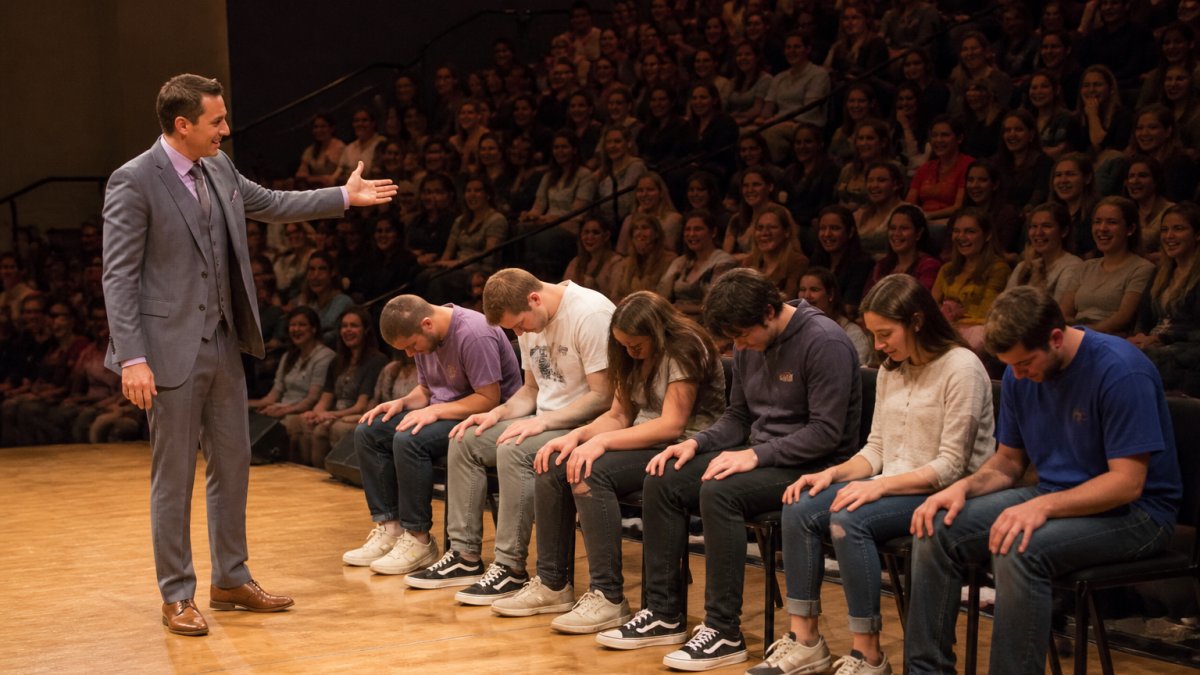
The structure rarely changes. The host opens with comedy and audience warm-up, then calls for volunteers.
What makes a college hypnosis show work is restraint.
A common mistake is assuming the whole crowd gets hypnotized. Most students simply watch and laugh.
Inside a College Mentalist Show: Reading the Room
A college mentalist show trades volunteers for mystery. The performer appears to read minds, predict choices, and reveal hidden details, all while students participate from their seats.
The format suits larger crowds because no one has to leave their seat.
Why it lands on campus:
- Low barrier to entry: Students participate from the audience.
- Universal appeal: Mystery works across majors and personalities.
- Conversation starter: The “how did he do that” debate lasts for days.
A college mentalist show pairs well with a hypnosis act for a longer program. The mentalism warms the crowd, and the hypnosis closes with bigger laughs.
Your College Show Booking Checklist
Booking a campus performance is a logistics job, not a talent search. Most of the work happens before the performer loads in, and smooth-running schools treat the process as a sequence of approvals rather than a single purchase. This college show booking checklist keeps it on track from first email to final curtain.
| Step | What to Do | Timing |
|---|---|---|
| 1. Define the goal | Set attendance, engagement, and budget targets; identify which office owns the event | 4-6 months out |
| 2. Check the calendar | Confirm date against exams, breaks, home games, and rival events | 4-6 months out |
| 3. Confirm funding | Route the fee through student activity fees, programming board funds, or departmental budgets | 3-5 months out |
| 4. Vet the performer | Review full-length live footage, not just a highlight reel; call two references | 3-4 months out |
| 5. Request the rider | Get the technical and hospitality rider in writing before you commit to a venue | 3-4 months out |
| 6. Confirm the venue | Check stage dimensions, ceiling height, power, lighting, and load-in access against the rider | 2-3 months out |
| 7. Sign the contract | Lock deposit, cancellation terms, force majeure, and backup plan | 2-3 months out |
| 8. Book campus logistics | Reserve parking, security, custodial, and AV staff through the appropriate offices | 6-8 weeks out |
| 9. Promote the show | Book social posts, flyers, tabling, and student org partners | 4-6 weeks out |
| 10. Run the day | Assign a student liaison and a tech contact; do a walk-through before doors | Event week |
The Rider Is Where Bookings Break
The technical rider lists what the show needs: stage size, sound inputs, lighting states, microphone types, and sometimes a piano or specific sightline. The hospitality rider covers dressing room, water, parking, and meals.
A common pattern is a venue that looks large enough on a tour but has a low ceiling or shallow stage, ruling out certain staging. Read the rider against the actual room before you sign, not after.
Questions to Ask Before You Sign
The contract matters as much as the show. Ask these before you commit:
- What happens if the performer gets sick or cannot travel? Is there a written backup plan or a substitution clause?
- What is the cancellation policy on both sides, and what deposit is refundable?
- Does the contract include a force majeure clause covering weather, illness, and campus emergencies?
Skipping the backup-plan and force majeure questions is the most common booking mistake. A performer who falls ill the week of your event without a written contingency leaves you with a dark stage and a full auditorium. Get the answer in writing before you sign.
Campus Approvals Most Planners Forget
A signed performer contract is not the end of the approval chain. Most campuses require separate sign-offs on their own timelines: student activities for funding, facilities for venue use, campus security for crowd management, and risk management for insurance and waivers.
A student liaison who knows the campus approval map is worth more than a bigger marketing budget. Assign one early.
Budgeting, Logistics, and Keeping Participation Voluntary
Pricing for campus entertainment depends on the date, venue, travel distance, and program length. We quote each event individually, so ask for a current quote rather than working from a generic number. What you can do now is build a budget framework that holds up when the quote arrives.
A Budget Framework You Can Defend
Most campus programming boards approve a total event cost, not just a performer fee. Build the budget around these lines so nothing surprises the finance office:
- Performance fee: The core cost, quoted per event. This is the number performers publish and the number most planners anchor on.
- Travel and lodging: Often separate for out-of-area bookings. Ask whether travel is billed at a flat rate or reimbursed at cost, because the two behave very differently when flights move.
- Per diem and ground transport: Meals, airport transfers, and local mileage. Small line items that add up on multi-day trips.
A useful trade-off to understand: a lower fee often means a performer who travels with less production support, which shifts more technical work onto your venue staff. A higher fee may include a fuller rider and a smoother load-in. Compare total event cost, not sticker price.
Logistics That Decide the Night
Confirm stage dimensions, ceiling height, power access, and load-in doors early, and match them against the rider. Assign one student liaison to meet the performer and one tech contact for lighting and sound.
Parking and security are the two most commonly forgotten logistics. A performer arriving with a vehicle needs a reserved space near the load-in door, and a crowded auditorium needs a crowd-management plan that campus security has signed off on. Book both through the appropriate office weeks ahead.
Keeping Participation Voluntary
Participation must stay voluntary, always. A tasteful show never pressures a student to volunteer. The host explains what will happen, invites hands, and respects every no.
A strong host explains the process before the call for volunteers, offers a clear way to decline without drawing attention, and checks in with each volunteer during the bit. If a student freezes or wants out, the host has a graceful exit ready and never makes the student feel foolish.
The strongest safeguard for audience participation is a performer who explains the process up front and gives students a clear, comfortable way to decline. Consent is not a formality. It is what makes the show work.
Accessibility belongs in the plan too. Reserve seating for students with mobility needs, provide captioning or a sign language interpreter when requested, and keep aisles clear. Build those requests into the venue booking, not the week of the event, because interpreter and captioning services often need lead time.
How to Measure Whether the Show Landed
You will know within a week whether the show worked. The signals are hard to miss.
Track these measures:
- Attendance: Compare turnstile count to your target.
- Volunteer rate: How many students raised a hand?
- Post-event chatter: Social mentions, group chats, and word of mouth.
A show that lands produces conversation. Students quote bits, tag each other in photos, and tell friends who skipped it that they missed out.
For a fuller picture, pair the survey with a quick debrief from your student org partners. They hear the hallway talk you do not.
Frequently Asked Questions
What makes a stage show interactive for a college audience?
A show is interactive when students on stage and in the seats shape what happens next. That usually means volunteers pulled from the crowd, moments where the whole room responds, and material that references campus life. Interactive stage shows for colleges work because the audience is not watching a scripted play; they are part of the outcome. Ask a performer how many points of participation exist in a typical 45-minute set before you book.
How do we keep audience participation comfortable and voluntary?
Build consent into the plan, not the performance. Use sign-up sheets or a raised hand for volunteers, never pressure anyone from the aisle, and brief your student leaders on how to step in if someone freezes. A college mentalist show can run entirely with seated volunteers and no physical contact. Confirm with the performer that anyone can leave the stage at any time and that no one is singled out for embarrassment.
What should colleges ask a performer before booking a show?
Walk through a college show booking checklist: proof of insurance, a cancellation and backup plan, technical requirements for lighting and sound, show length, content boundaries, and references from similar campus events. Ask what happens if a volunteer becomes uncomfortable and how the performer handles a crowd that gets loud. Get the answers in writing so your activities office and administration can sign off without surprises.
How long should an interactive college stage show be?
Most campus shows land between 45 and 60 minutes, which fits an assembly block or an evening event without losing the room. Orientation programs often prefer 30 to 45 minutes because students are moving between sessions. Tell the performer your slot and ask whether they can scale up or down. A college hypnosis show that runs long tends to lose energy near the end, so match the length to your schedule rather than the other way around.
Planning a campus event means balancing budget, logistics, and a crowd that has seen everything. Dusty Satterlee brings 15 years of stage experience, training under veteran international stage hypnotist Michael C. Anthony, and membership in Stage Hypnosis University to every performance. The result is a tasteful, elegant show built to fill seats and start conversations. Book a show with Dusty Satterlee and give your students a night they will still be talking about at commencement.
