

Last Updated: November 14, 2026
Quick Summary
Measuring audience response means defining your goals before the show, watching the room, tracking laughter and applause, recording crowd audio, and surveying attendees afterward. Combining these signals shows whether the comedy actually served the event’s purpose, rather than relying on gut feeling.
- Write one or two observable outcomes you want before the show starts, not vague goals like a good time.
- Place a recorder two-thirds of the way back in the audience, since stage-side recorders mostly capture the performer.
- Score laughter, cheering, and applause as small, medium, or large every 5 to 10 minutes to build a timeline.
- Send the post-event survey within 24 to 48 hours and send one reminder three to four days later.
- Check timing, room setup, and crowd mood before judging the performer, since venue conditions can distort results.
Table of Contents
- Step 1: Define What Success Looks Like Before the Show
- Step 2: Read the Room During a Comedy Show
- Step 3: Track Laughter, Cheering, and Applause
- Step 4: Capture Audio and Use Measurement Tools Reliably
- Step 5: Ask the Right Post-Event Questions
- Separating Performer Impact from Venue and Crowd Conditions
- Booking Your Next Show With Confidence
- Frequently Asked Questions
Many event planners judge a comedy booking by gut feeling: the room laughed, people stayed late.
Measuring audience response means watching, recording, and asking questions so you can say with confidence whether the entertainment did its job.
Here is what a useful measurement approach covers:
- What you wanted the audience to feel before the show starts
- What you saw in the room while the performance was running
- What you heard, including laughter, cheering, and applause
Audience feedback matters most when the event has a clear purpose. A fundraiser needs donations. A student assembly needs attention and a takeaway message.
Step 1: Define What Success Looks Like Before the Show
Start with the goal, not the performer. Write down one or two outcomes you want before anyone steps on stage.
A common mistake is aiming for “a good time.” That goal is too vague to measure. Instead, pick something you can observe:
- Most of the room stays seated through the full program
- Students talk about the show in class the next day
- Donors mention the entertainment when they give
Once you have two or three targets, you know what to watch for and what to ask later. To decide what good response looks like for your crowd, see how to match comedy styles to different audiences. This step takes about 15 minutes and makes every other step easier.
Step 2: Read the Room During a Comedy Show
Reading the room means paying attention to the crowd while the show runs. Your eyes and ears provide data no survey can capture.
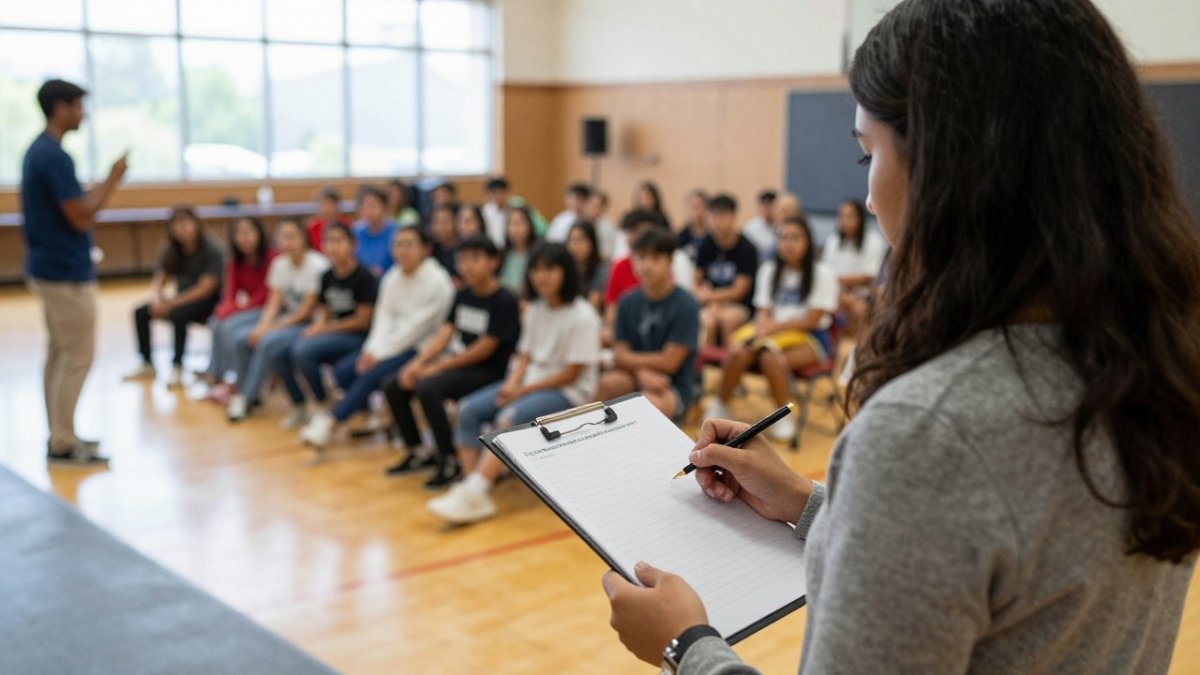
Watch for these signs of engagement:
- Heads turning toward the stage as a volunteer walks up
- People leaning forward or laughing before a punchline lands
- Friends pointing at each other during a moment that worked
Watch for these signs that attention is slipping:
- Side conversations growing louder
- People checking phones or leaving early
- Long quiet stretches where no one reacts
Stand in a few different spots during the show. A seat in the back gives a different view than one near the front. Note what you see at roughly 10-minute intervals so you can match moments to what happened on stage.
Step 3: Track Laughter, Cheering, and Applause
Sound is one of the easiest signals to track. Laughter, cheering, and applause show where the audience connected.
You do not need expensive tools to start. Try this simple method:
- Pick a point in the program every 5 to 10 minutes.
- Write down whether the response was small, medium, or large.
- Note whether the room went quiet at any point.
- Mark any moment where the room clearly erupted.
Over a full show, this gives you a rough timeline. Large responses clustered in the middle and a flat ending suggest the strongest material came early. A slow start with a big finish suggests the opening needed more energy.
Step 4: Capture Audio and Use Measurement Tools Reliably
Handwritten notes tell you what one observer noticed. A recording tells you what the room actually did, second by second. The catch is that most phone recordings capture the performer’s microphone and almost none of the crowd. Getting usable audience audio is a setup problem before it is an analysis problem.
Set Up the Recording Correctly
A few placement decisions determine whether the file is worth keeping:
- Put the recorder in the audience, not at the stage. A recorder on the stage lip or next to a speaker picks up the performer and the PA, burying the crowd response. Place it two-thirds of the way back, slightly off-center, at seated head height.
- Use two recorders if you can. One near the front third and one near the back lets you compare how response carried. The back recorder is the honest one: if the back of the room is quiet, the show is not reaching the back of the room.
- Set levels before doors open, not during the show. Ask someone to clap and laugh at performance volume while you watch the meter. Aim for peaks around two-thirds of the scale so a big laugh does not clip into distortion.
Watch out: a recorder left running through the whole event captures side conversations, names, and private remarks, so decide in advance when recording starts and stops and tell attendees.
Turn the Recording into Data
A raw audio file is not a measurement until you extract something countable. The simplest reliable method is a timed listen-back:
- Play the recording and mark every audible laugh, applause burst, and cheer with a timestamp.
- Score each one on a three-point scale, small, medium, large, using the same scale every time.
- Note the gaps: stretches longer than about 30 seconds with no audible response are as informative as the big laughs.
- Total the marked responses and divide by the runtime of the set to get responses per minute, a number comparable across shows in a way that “it went well” is not.
Automated tools can speed up the counting, and some event and audience-response platforms will flag laughter or applause for you. Treat their output as a first pass, not a verdict. Automated emotion and laughter detection is sensitive to music, applause, and room noise, and it cannot tell a laugh at the performer from a laugh at a heckler. Spot-check a sample of the flagged moments by ear before you trust the totals.
Handle Consent, Privacy, and Retention
Recording an audience is a data-handling decision, not just an AV decision. Before the event:
- Put a notice in the program, the pre-event email, or a sign at the door stating that audio is being recorded for event review.
- If the venue, school district, or employer has a recording or media policy, follow it and get the sign-off in writing.
- Keep the file on a secured drive, limit who can access it, and set a deletion date, 30 to 90 days after the event is common.
Keep the Tool Set Small
You do not need a dashboard to start. A recorder, a stopwatch, a one-page scoring sheet, and a shared spreadsheet cover most of what a planner needs. Add survey software or an audience-response app only when you have a specific question the spreadsheet cannot answer. The tool should serve the goal you wrote down in Step 1, not become the goal.
Step 5: Ask the Right Post-Event Questions
Observation and audio tell you what the room did. Before booking, it also helps to know which questions to ask a mentalist so your post-event survey measures expectations you set in advance. A survey tells you what people carried home. The two often disagree, and the disagreement is the most useful thing you will learn. A crowd can laugh hard and still rate the event as not relevant to why they came.
Design the Survey Around Your Step 1 Goals
Every question should map to an outcome you wrote down before the show. If a question does not connect to a goal, cut it.
A workable structure:
- One overall rating on a five-point scale, so you have a single number to compare across events.
- Two or three goal questions tied to your stated outcomes, for example, “Did the entertainment support the purpose of this event?” or “Would you recommend this program to a colleague?”
- One recall question, “What is the first moment you remember from the show?”, which surfaces which bits actually stuck.
Avoid leading wording. “How much did you love the show?” produces a different answer than “How would you rate the entertainment?” Keep the scale consistent across events so the numbers mean the same thing year to year.
Get a Usable Response Rate
A survey with a 5 percent response rate is anecdote, not data. Push the rate up with timing and channel:
- Send within 24 to 48 hours, while the show is still fresh.
- Send from a person, not a no-reply address, and keep the subject line plain.
- Send one reminder, three to four days later, and then stop.
In-person events with a QR code on the exit table often get a higher response rate than email-only follow-ups, because the ask happens while people are still in the room.
Combine the Signals into One Scorecard
No single metric should decide whether a show worked. Build a one-page scorecard that puts the signals side by side:
| Signal | What it tells you | How to read it |
|---|---|---|
| Responses per minute from the recording | How often the room reacted | Compare within the same format and room type, not across them |
| Longest quiet stretch | Where attention dropped | Match the timestamp to the program to find the weak segment |
| Overall survey rating | How people felt afterward | Compare against your own prior events, not a national average |
| Goal-question scores | Whether the event did its job | This is the number that matters most to the person who approved the budget |
| Attendance and retention | Whether people stayed | Early departures are a response signal in themselves |
| Recommendation intent | Whether people would book again | The strongest predictor of repeat business |
| Open-ended comments | Why the numbers look the way they do | Read these before you change anything |
Interpret Before You Act
A single event gives you a snapshot, not a benchmark. Laughter-per-minute figures get quoted as if there were a universal target, but response rates vary with format, crowd size, room layout, and time of day.
Compare like with like: same format, similar room, similar time slot. Look for a pattern across three or four events before you change your booking.
Separating Performer Impact from Venue and Crowd Conditions
A flat show does not always mean a weak performer. Sometimes the problem is the room, the schedule, or the crowd itself.
Before you judge the performer, check these conditions:
- Timing: Was the show scheduled when people were tired or hungry?
- Room setup: Could everyone see and hear the stage?
- Crowd mood: Had the group just received difficult news or a long lecture?
Note these conditions each time you compare results across events.
This separation matters most for planners who book the same kind of entertainment every year. It keeps you from dropping a good performer because of a bad lunch slot.
Booking Your Next Show With Confidence
Measuring response helps you make better decisions next time. If you are planning a fundraiser, the seven steps to booking comedy hypnosis for fundraisers walk through the process from start to finish.
If you are planning a school assembly, a fundraiser, or a corporate event and want entertainment that is elegant, tasteful, and built to get people talking, Dusty Satterlee offers comedy stage hypnosis and mentalism for high schools, colleges, and corporate functions. For guidance on booking mentalists for company events, see the planning guide for corporate groups.
For current pricing, availability, and to check whether a show fits your date and budget, visit the Dusty Satterlee website and request a quote. Read how much hiring a hypnotist typically costs to see what shapes the price before you ask.
Ready to plan your event? Book A Show and start building a memorable program your audience will talk about.
Frequently Asked Questions
How do you measure audience response to a live comedy performance?
Combine several signals rather than relying on one. Count laughter and track how often it occurs, note cheering and applause, observe whether attendees lean in or check their phones, and collect short written or digital feedback after the show. Compare these results against the goals you set before the event. A single loud moment says little, but consistent laughter across the set, steady attention during quieter material, and positive post-show comments together show how well the performance landed with your specific crowd.
What questions should you ask guests after a comedy performance?
Keep surveys short, ideally three to five questions. Ask how much they enjoyed the show on a simple scale, which moment stood out, whether the material felt appropriate for the audience, how likely they are to attend a similar event, and whether they have suggestions. Avoid leading questions that presume a positive answer. Separate questions about the performer from questions about the venue, sound, or timing so you can tell which factor shaped the experience.
How can you tell whether a comedy set is working for a mixed audience?
Watch for laughter spread across different groups in the room rather than only from one section. If only a small cluster responds while others stay quiet, the material may be landing with a narrow slice of the crowd. Check whether attendees re-engage after a quiet moment, and collect feedback that asks specifically whether the content felt inclusive. Recording the show and reviewing it afterward helps you catch patterns you may miss while watching live.
Can audience response tools measure laughter at a live event?
Some audio analysis tools can estimate laughter frequency and duration from a recording, but results depend heavily on microphone placement, room acoustics, and background noise. Treat automated counts as one input alongside manual observation and surveys. Always obtain consent before recording attendees, and review your local privacy expectations for any audio you capture, especially at schools or with minors present.
