

Last Updated: November 5, 2026
Quick Summary
Match comedy styles to audiences by segmenting on psychographics before demographics, then filtering by age and group type. Novelty seekers reward improv and crowd work, while comfort seekers prefer clean observational humor and storytelling. Physical comedy and character work bridge mixed-age and multilingual rooms most reliably.
- Score seating density, pre-show noise, and phone posture on a 1-to-5 scale before the show.
- A walk-through total of 11 or higher means you can open with crowd work.
- Corporate teams fit clean observational and storytelling; avoid blue and shock humor.
- Build a 5 minute set as opener, relatability, one big moment, escalation, and clean close.
- Ask performers for footage from different crowd types and how they handle a joke that fails.
Table of Contents
- Why Audience Fit Decides Whether a Comedy Set Lands
- The Main Comedy Styles and What Each One Does to a Room
- How to Read the Room Before You Book
- The Best Comedy Styles for Different Audiences, Segment by Segment
- Why Clean Comedy for Corporate Events Beats Edge for Its Own Sake
- Comedy for College Events: Crowd Work, Relatability, and Timing
- Building a 5 Minute Comedy Set That Fits the Room
- Booking a Performer Who Adapts to Your Audience
- Frequently Asked Questions
Why Audience Fit Decides Whether a Comedy Set Lands
The right comedy styles for different audiences can turn a flat room into a night people talk about for weeks.
A joke that kills at a college show can bomb at a corporate dinner. Same words, different room.
That gap is where most event entertainment fails. For a deeper guide on avoiding awkward comedy for events, see our full breakdown.
Below, we break down the main comedy styles, how to read a room, and how to match each one to your audience.
The Main Comedy Styles and What Each One Does to a Room
Each comedy style does a specific job to a crowd. Some pull people in close; others push them back.
Observational Humor, Storytelling, and One-Liners
Observational humor finds the funny in daily life. It works because people recognize themselves in the jokes. Relatability carries the laugh.
Storytelling builds a slow payoff. The comic sets a scene, adds detail, then lands the punchline at the end.
One-liners hit fast and hard. They suit short sets and crowds with short attention spans.
Physical Comedy, Improv, and Character Work
Physical comedy and slapstick cross language and age barriers. A well-timed fall or gesture gets a laugh without a single word.
Improv and crowd work turn the audience into part of the show. This works when the crowd is warm and willing.
Character comedy and deadpan delivery reward viewers who pay close attention. Satirical wit and topical humor land best when the crowd shares the same cultural context.
How to Read the Room Before You Book
Reading a room separates a smooth event from an awkward one. What a booker or performer needs is a repeatable diagnostic that produces a decision in under a minute.
We use a four-stage “Read the Room” diagnostic that runs from the parking lot to the first punchline.
Stage 1: Pre-Show Intel (Before You Arrive)
Gather four data points from the organizer before the event:
- Age distribution. Ask for a rough percentage split (for example, 60% over 45, 40% under 30). Mixed rooms need physical comedy and character work; a tight 25-to-35 room can absorb topical and crowd work.
- Group type. Celebration, mandatory, fundraising, or educational. A mandatory meeting crowd starts colder and needs a safer opener.
- Alcohol presence. A cash bar changes pacing. Crowds two drinks in laugh sooner but follow long stories less patiently.
Watch out: organizers routinely describe the audience they wish they had, not the one in the seats. Cross-check the age split against the venue and event type.
Stage 2: The 60-Second Walk-Through (On Arrival)
Before the show starts, walk the room and score three signals on a simple 1-to-5 scale:
- Seating density. Packed front rows signal a warm, willing crowd. Empty front rows with a full back half signal a skeptical room that needs a strong, safe opener.
- Pre-show noise level. Loud chatter means high energy you can ride. Near-silence in a full room means tension you must break deliberately.
- Phone posture. Phones down means attention is available. Phones up means you need a physical or interactive hook in the first 30 seconds.
Add the three scores. A total of 11 or higher means you can open with crowd work. A total of 6 or lower means open with your safest, most relatable observational bit.
Stage 3: The First 30 Seconds (Live Calibration)
Your opener is a test, not just a laugh. Deliver one safe, recognizable observation and read the response:
- Laugh plus eye contact, the room is with you. Escalate toward crowd work and topical material.
- Laugh but no eye contact, polite room. Stay in storytelling and observational lanes; do not pull anyone onstage yet.
- Scattered or delayed laugh, the room is deciding. Slow down, shorten your sentences, and land a second safe laugh before attempting anything edgy.
Stage 4: The Adjustment Decision
By the 90-second mark you should have made one of three calls: stay the course, soften the material (drop blue or satirical bits, lean on physical and character work), or go interactive (crowd work and improv to warm a cold room). Write the call down after every show; over a season, those notes become your own audience database.
A common mistake is booking for the organizer’s taste instead of the audience’s needs. The planner loves edgy humor; the room is a school fundraiser. The diagnostic catches that mismatch before the first joke.
The Best Comedy Styles for Different Audiences, Segment by Segment
The best comedy styles for different audiences depend on the group in front of you. Two crowds with the same age range can want completely different comedy depending on why they gathered and how they consume humor. Below is the demographic baseline, followed by the two layers most guides skip: psychographics and delivery format.
The Demographic Baseline
| Audience | Best-Fit Styles | Avoid | Why It Works |
|---|---|---|---|
| Corporate teams | Clean observational, storytelling | Blue comedy, shock humor | Protects morale and brand image |
| College crowds | Crowd work, improv, topical humor | Slow, gentle material | Matches high energy and short attention |
| High school assemblies | Physical comedy, relatability | Dark comedy, cringe comedy | Keeps content tasteful and inclusive |
| Fundraising galas | Storytelling, clean satire | Heckling-based sets | Keeps donors comfortable and generous |
| Mixed-age groups | Physical comedy, character work | Inside jokes, niche references | Crosses generational lines |
For corporate groups, our corporate entertainment options show how a clean, high-energy set fits a team event. Match the style to the crowd’s comfort level, not to the performer’s favorite material.
Layer 2: Psychographics Beat Demographics
Age and job title tell you less than you think. Two 40-year-old crowds can sit in the same ballroom and want opposite comedy. Segment on four psychographic axes instead:
- Novelty seekers vs. comfort seekers. Novelty seekers reward improv, crowd work, and topical material. Comfort seekers reward familiar observational humor and clean storytelling. A gala donor base skews comfort; a tech launch party skews novelty.
- In-group vs. outsider identity. A room that already shares an identity (a trade association, a graduating class, a church group) can absorb inside references and gentle self-satire. A mixed public room cannot.
- Stakes sensitivity. High-stakes rooms (sales kickoffs, investor dinners, fundraisers with a gift of honor) need material that cannot embarrass a named individual. Low-stakes rooms (comedy clubs, birthday parties) can absorb roast and heckling formats.
A practical rule: build your set list around the psychographic axis first, then filter by demographic.
Layer 3: Live vs. Short-Form Delivery Changes the Style
The same joke that lands in a club can die on a phone screen, and vice versa.
- Live club or theater sets reward storytelling, character work, and slow builds. The audience is captive, the room is shared, and laughter is contagious. A four-minute story with a late payoff is an asset here.
- Short-form social clips reward one-liners, physical gags, and a hook in the first two seconds. Crowd work clips travel well because the reaction is visible, but the setup must be legible without context.
- Hybrid corporate sets (live show plus a highlight reel for internal sharing) need material that reads both ways. Clean observational bits with a visual or physical component survive the edit; topical references tied to the room do not.
If you are booking a live event and the organizer plans to post clips afterward, ask which bits are cleared for sharing. A joke that depends on a specific audience member or a local reference will not survive the cut.
Cross-Cultural Adaptation: Translating Styles, Not Just Jokes
Diverse rooms are the norm, not the exception. The mistake is assuming a style that works for one cultural group works for a mixed one.
- Sarcasm and deadpan depend on shared tone cues. In a mixed or international room, deadpan can read as sincere and sarcasm as hostility. Pair them with a clear signal that a joke is a joke.
- Slapstick and physical comedy cross language and cultural lines most reliably, the safest bridge in a multilingual room.
- Satire and topical humor require shared news context. Keep topical material to widely known public events and avoid region-specific references.
A common pattern among working comics is to open a mixed room with physical or universal observational material, then earn the right to go topical once the room has agreed on a shared tone. A joke that gets a huge laugh from one segment and silence from another signals the room has split, and the next bit needs to reunite it.
Why Clean Comedy for Corporate Events Beats Edge for Its Own Sake
Clean comedy for corporate events wins because it protects the room. A company dinner mixes executives, new hires, and clients.
Edge has its place. Shock humor and blue comedy can work with the right crowd. But “edgy” is not a strategy.
Here is what clean comedy buys you:
- No awkward silences from a joke that crossed a line
- No complaints from HR the next morning
- No risk of offending a client or a guest of honor
The trade-off is real. Clean comedy asks more of the performer. It takes sharper writing to get a laugh without a cheap shock.
Comedy for College Events: Crowd Work, Relatability, and Timing
Comedy for college events runs on energy and timing. College crowds are quick, loud, and restless.
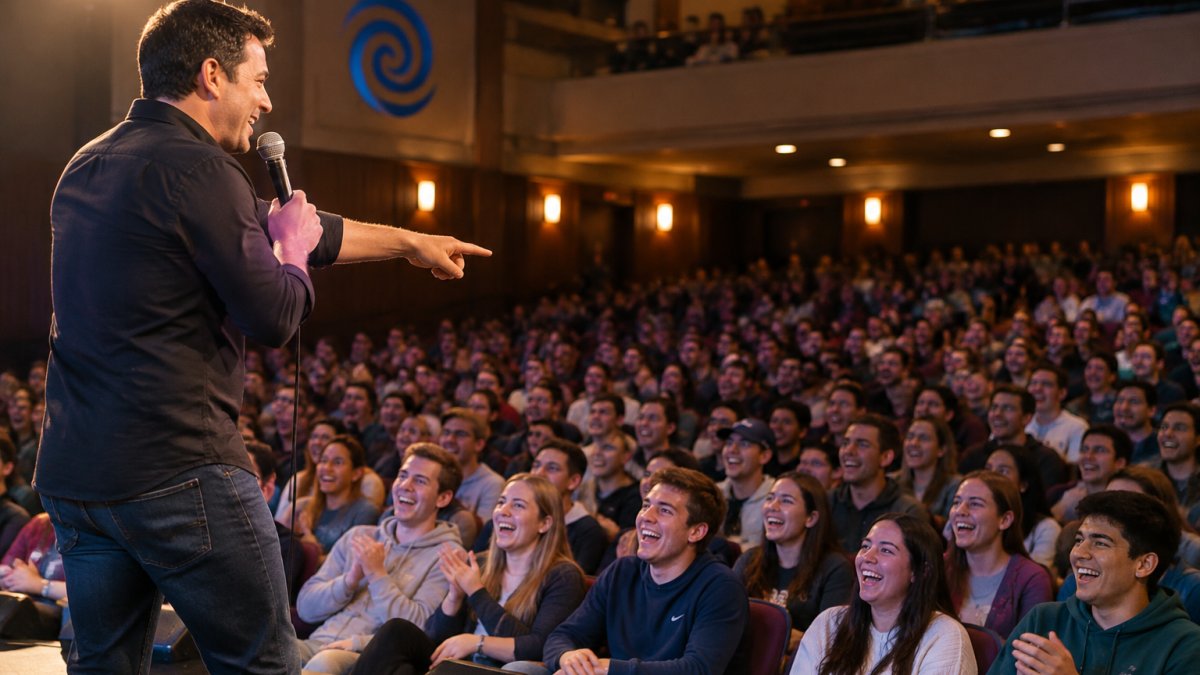
Crowd work is the secret weapon here.
Timing is everything. A college set needs a strong opener in the first 30 seconds.
Our college event entertainment is built for exactly this kind of crowd: high-energy, interactive, and tuned to a student audience. The goal is simple.
Building a 5 Minute Comedy Set That Fits the Room
A strong 5 minute comedy set follows a clear structure. Five minutes is short. Every second has to earn its place.
Here is the framework we use:
- Open strong (0:00-0:30). Lead with your best, safest laugh to win the room.
- Build relatability (0:30-2:00). Use observational humor the crowd recognizes.
- Add one big moment (2:00-3:30). A story, a bit of crowd work, or a physical gag.
- Escalate (3:30-4:30). Raise the energy and stack the laughs.
- Close clean (4:30-5:00). End on a strong line and leave them wanting more.
A common mistake is cramming too many jokes into five minutes. Pace beats volume.
Also, build in a buffer. Crowd work can run long, and a set that respects its time slot reads as professional.
Booking a Performer Who Adapts to Your Audience
The best comedy styles for different audiences only work if the performer can shift between them.
Ask three questions before you book:
- Can the performer show footage from different crowd types?
- How do they handle a joke that does not land?
- What is their plan if the audience is not what you expected?
Our performance videos show how a live act reads and works a crowd.
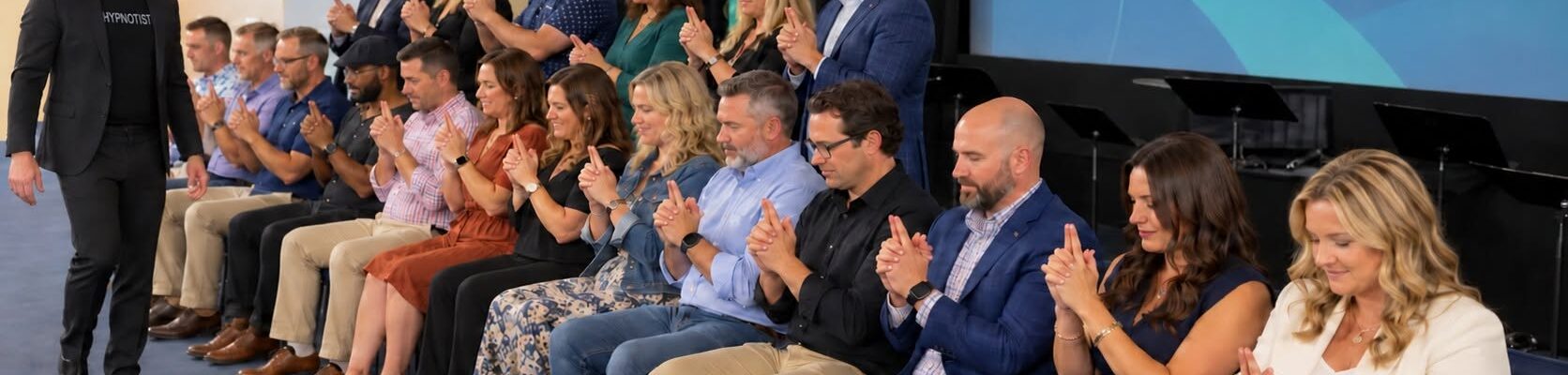
Dusty Satterlee brings more than 15 years of experience and training under veteran international stage hypnotist Michael C.
When you are ready to lock in a date, you can book a show and tell us about your crowd.
Matching comedy to a crowd is the difference between a night people remember and one they forget by Monday.
Frequently Asked Questions
What type of comedy works best for a corporate event?
Clean comedy built on observational humor and shared workplace situations usually works best. Corporate crowds are mixed in age and seniority, so material that avoids politics, religion, and crude language keeps everyone comfortable. A performer who uses audience participation and crowd work, rather than a fixed script, can adjust on the spot if a joke does not land. Ask any act for a sample of their corporate material before you book, and confirm the set length fits your program.
How do you choose a comedy style for a mixed-age audience?
Start with the youngest and oldest people in the room and find the humor they share. Physical comedy, observational humor about everyday life, and storytelling tend to cross generational lines better than topical humor tied to current events. Avoid inside references that only one group will recognize. A performer experienced with school assemblies and family events will usually open with broad material, watch the audience reaction, and adjust the rest of the set from there.
How long should a comedy set be at an event?
For a school assembly or a corporate break, 20 to 45 minutes is typical for a headline act, while a 5 minute comedy set suits openers, showcases, and award segments. Shorter sets reward tight material and one strong closing bit. If comedy is part of a larger program with speakers and awards, keep it under 30 minutes so energy stays high. Confirm timing with the performer in advance and build in a buffer for setup.
Is clean comedy suitable for every event?
Clean comedy fits most school, corporate, and fundraising events because it removes the risk of offending donors, parents, or leadership. It does not mean dull: observational humor, improv, and crowd work can carry a full set without edgy material. For college crowds, some performers use a slightly looser style, but the safest approach is to agree on boundaries in writing before the event. Tell the performer your audience mix and any topics to avoid.
