

Last Updated: November 4, 2026
Quick Summary
Campus event accessibility means removing physical, sensory, and communication barriers before, during, and after an event so every student, guest, and staff member can take part. Name one accessibility coordinator early, give them authority, and build access into every decision from venue selection onward. Most failures are timing failures, not budget failures.
- Name one accessibility coordinator with authority and a backup rather than relying on a committee.
- Temporary pop-up events still need an accessible route, seating, restrooms, and effective communication.
- Run your accessibility checklist at eight weeks out, two weeks out, and the morning of the event.
- Confirm each accommodation in writing with the specific arrangement, not just a note that it was received.
- Write a fallback plan for every confirmed accommodation before the event starts.
Table of Contents
- Start Accessibility Planning Early and Assign One Owner
- ADA Requirements for Temporary Events on Campus
- Your College Campus Event Accessibility Planning Checklist
- Plan for Interpreters, Captioning, and Hybrid Delivery
- Budget for Accommodations and Measure What Worked
- Book Entertainment That Works for Every Audience
- Frequently Asked Questions
Start Accessibility Planning Early and Assign One Owner
College campus event accessibility planning is the process of removing physical, sensory, and communication barriers before, during, and after a campus event so every student, guest, and staff member can take part.
The fix is structural: name one owner early, give that person authority, and build access into every decision from venue selection onward. Below, we break down who does what, what federal rules apply, and how to plan a show that reaches every audience.
Who Owns Accessibility on Your Event Team
One named accessibility coordinator beats a committee every time. That person owns the checklist, fields accommodation requests, and has the standing to say no to a venue or layout that blocks people. Give them a backup, too. Events fall apart when the single owner gets sick the week of the show.
A workable split looks like this:
- Accessibility coordinator: owns planning, requests, and on-site fixes
- Venue liaison: confirms entrances, restrooms, and load-in access
- Communications lead: publishes access info and handles registration
ADA Requirements for Temporary Events on Campus
Temporary events on campus fall under the ADA, and the rules apply to pop-up setups just as they do to permanent buildings. Under the ADA Title III regulations, places of public accommodation must provide goods and services in an accessible manner, and that includes short-term events open to the public. The practical takeaway: a one-night show still needs an accessible route, accessible seating, and effective communication.
What the ADA Covers at a Pop-Up Event
The basics apply even when the event lasts four hours:
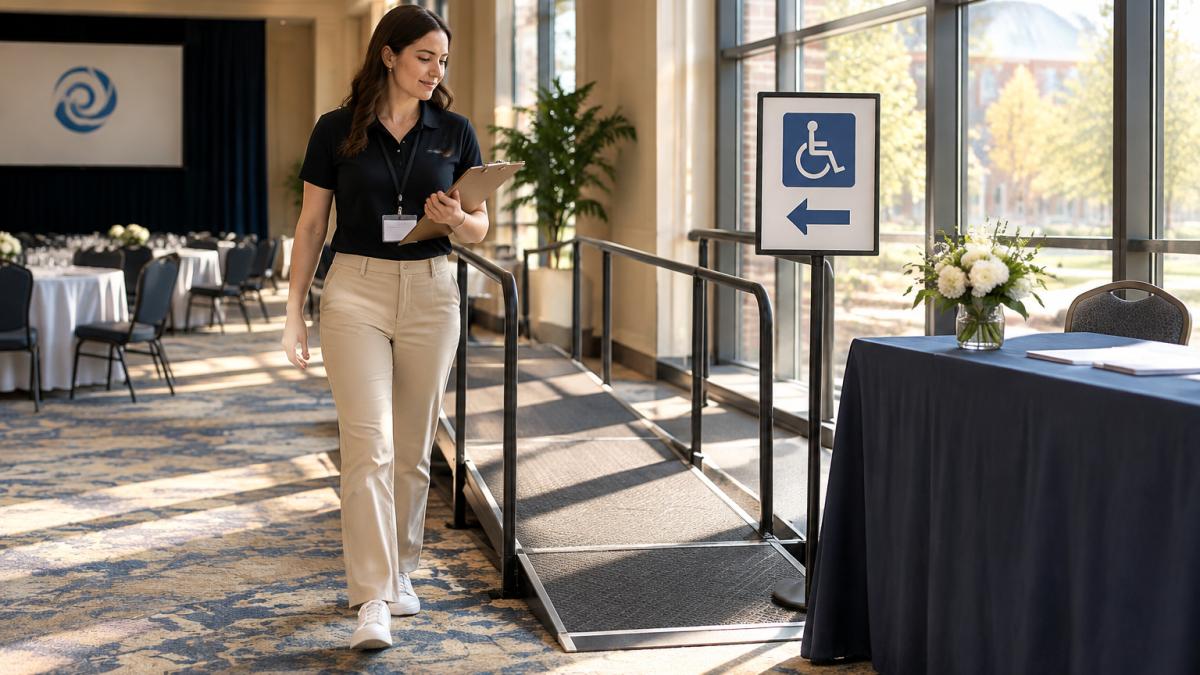
- An accessible entrance connected to an accessible route
- Accessible parking and a drop-off point near the door
- Seating with clear floor space for wheelchairs and companions
Your College Campus Event Accessibility Planning Checklist
A college campus event accessibility planning checklist turns good intentions into assigned tasks with dates. Run it at three checkpoints: eight weeks out, two weeks out, and the morning of the event.
(/blog/is-stage-hypnosis-safe-for-schools/) before you book.
Plan for Interpreters, Captioning, and Hybrid Delivery
Effective communication covers sign language interpreters, captioning, and assistive listening, and hybrid delivery adds a second layer. If you stream the event, caption the stream live and check that the platform supports screen readers. Share accessible presentation materials in advance, with alternative text on images and a tagged PDF or plain document.
For virtual attendees:
- Test the stream with captioning before show day
- Assign a host to monitor the chat for access issues
- Record and caption the replay
Budget for Accommodations and Measure What Worked
Set an accommodation budget line before you book anything else. Interpreter hours, captioning, temporary ramps, and accessible shuttle service all carry costs, and pricing depends on the vendor, date, and scope.
Budget is only half the job. The other half is measuring whether the access you paid for actually worked, and turning what you learn into next year’s plan.
Track Accommodation Fulfillment, Not Just Requests
Count requests, but also count outcomes. Useful measures include:
- Number of accommodation requests received, by type
- Percentage confirmed in writing before the event
- Percentage fulfilled as confirmed on the day
These numbers tell you whether the workflow is working. A high request count with a low fulfillment rate is worse than a lower count with full fulfillment, because it means people asked and were let down.
Measure Route Usability and Reported Barriers
Walk the accessible route on event day with a checklist and, if possible, a wheelchair user or someone who uses a mobility device. Record any point where the route narrowed, a cable crossed the path, a door was hard to open, or signage was missing. After the event, ask attendees a short set of questions: Could you reach the seating area without help?
Close the Loop Publicly and Internally
Write a one-page after-action summary within two weeks of the event. List what worked, what failed, the fallback that was used, and the specific fix for next time, with an owner and a date. Share the summary with the accessibility coordinator, venue liaison, and student group leadership so the knowledge does not leave with one graduating class.
Watch out: treating a post-event survey as the whole evaluation. Satisfaction scores miss the people who could not attend or could not get in, so pair the survey with route checks, staff debriefs, and the fulfillment log.
Book Entertainment That Works for Every Audience
The hardest part of access is often the program itself. A show can have a perfect ramp and still leave half the room cold if the material does not land for a diverse crowd.
Ready to plan? See our work with colleges, watch video samples to judge the tone, and read the interactive stage shows for colleges guide for deeper planning. When you are ready, book a show.
Frequently Asked Questions
What are the ADA requirements for temporary events on campus?
Temporary events are subject to federal disability law, and you should confirm the specific obligations that apply to your institution with official guidance. In practice that means an accessible route from parking and transit to the event, accessible entrances, clear floor space at tables and registration desks, wheelchair-accessible seating with sightlines, and accessible restrooms. Event staff must be able to answer accommodation requests, and publicity should state how to make one. Temporary structures like stages and tents count, so plan barrier removal before setup day rather than after.
How do you make a college event accessible for students with disabilities?
Start with a campus event accessibility plan that names one coordinator and a timeline running from booking to follow-up. Build the accessible route, seating, and restroom access into the venue contract. Put an accommodation request line on every registration form and publicity piece, then confirm requests at least two weeks out. Add sensory-friendly touches like a quiet space and plain-language signage. After the event, collect participant feedback so the next one starts from a better baseline.
What should be included in a campus event accessibility checklist?
A working college campus event accessibility planning checklist covers accessible parking and transit drop-off, step-free paths of travel, accessible entrances and exits, clear floor space at the registration desk and food stations, wheelchair seating with stage sightlines, accessible restrooms, stage access for presenters, interpreter and captioning arrangements, assistive listening, alternative text on digital materials, quiet space, and a named staff contact. Add a contingency line for each item so a broken elevator or late interpreter does not derail the event.
How do you ensure digital accessibility for event registration?
Accessible event registration forms use proper labels, keyboard navigation, sufficient color contrast, and no time limits that lock people out. Include an open accommodation request field with a deadline, and state the deadline in the confirmation email. If you use a third-party platform, test it with a screen reader before launch. Publish an accessibility statement on the registration page that names a contact, and keep the same information available by phone for anyone who cannot complete the form online.
Every campus has at least one guest who quietly gives up and leaves early. The fix is a plan with an owner, a budget, and a checklist, not a last-minute scramble. Dusty Satterlee brings a tasteful, audience-aware show to campus events, backed by professional training, a style built for mixed crowds, and material that keeps students engaged instead of reaching for their phones. Get started with Dusty Satterlee and book entertainment your whole campus can enjoy.
