
Last Updated: November 8, 2026
Quick Summary
A mentalism show is a strong spirit week assembly because students become part of the act. A typical structure opens with an audience-wide prediction, moves through a few short volunteer effects, and closes with a group finale tied to school colors or the week’s theme.
- Keep each segment to a few minutes so the energy stays high throughout the assembly.
- A 45-minute all-school run-of-show includes an opening prediction, volunteer effects, a spirit tie-in and a group finale.
- Make every volunteer invitation optional, with a clear opt-out that requires no explanation.
- Confirm microphone setup, sightlines and volunteer walking routes before the assembly day.
- Adapt the material by grade level, using simpler visual effects for elementary and sharper humor for high school.
Table of Contents
- Why a Mentalism Show Works for School Spirit Week
- School Spirit Week Assembly Ideas Built Around Mentalism
- Spirit Week Ideas for High School Mentalism Performances
- Spirit Day Ideas for Elementary School Audiences
- A Complete Mentalism Show Run-of-Show
- Interactive School Assembly Ideas That Keep Students Safe and Included
- Booking Your Spirit Week Mentalism Show With Dusty Satterlee
- Frequently Asked Questions
Why a Mentalism Show Works for School Spirit Week
Spirit week asks students to show up, participate and feel part of something. A mentalism show does that better than most assemblies because the audience becomes the act. Mentalism and comedy stage hypnosis work for high schools, colleges and corporate events, and the format carries over to school spirit week more easily than most people expect.
Mentalism is performance that appears to reveal thoughts, predict choices or read minds. The effect depends on the audience staying involved, which is why students who might tune out a lecture tend to lean forward. The mind-reading premise also gives teachers a clean hook that works across grade levels without requiring costumes, a stage build or a large budget.
The strongest assemblies are often the ones students talk about afterward. A show that gets volunteers on stage, creates a shared moment and sends everyone back to class laughing does exactly that.
School Spirit Week Assembly Ideas Built Around Mentalism
A school spirit week assembly built around mentalism can follow a simple structure: open with an audience-wide prediction, move to a few volunteer effects, and close with a group moment that ties back to school colors or the week’s theme. Each segment should last only a few minutes so the energy stays high.
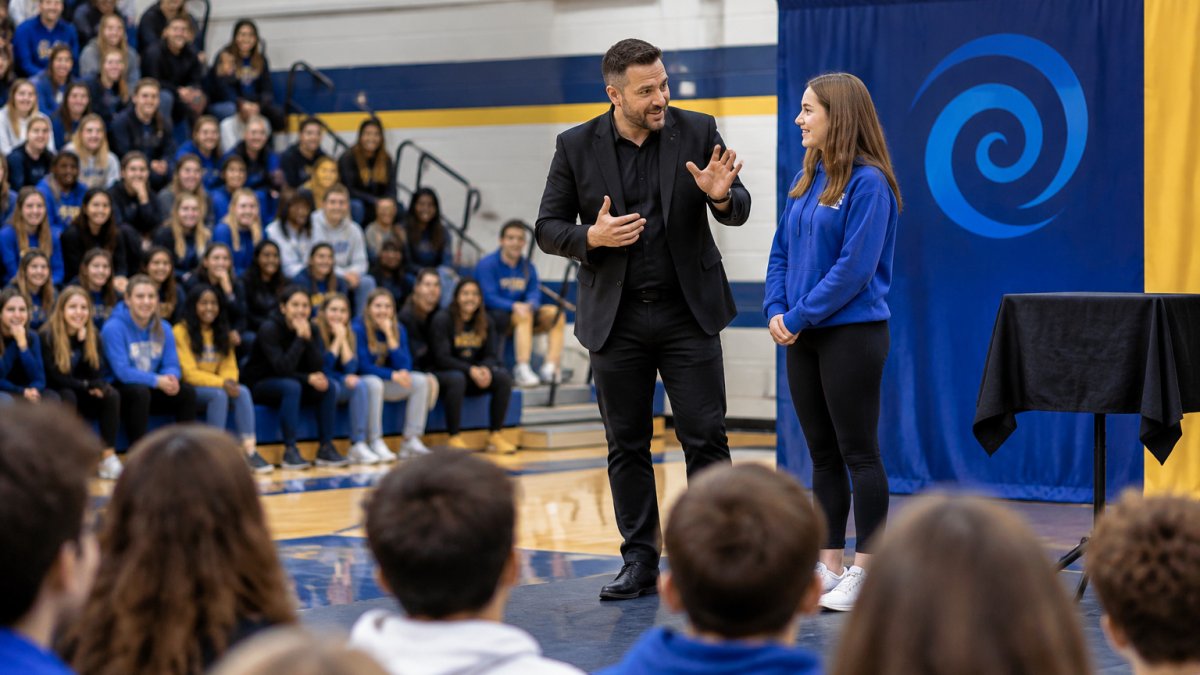
Some assembly ideas that schools commonly use:
- A “mind-reading” opener where the performer predicts a word written by the class before the assembly
- A color-based prediction that connects to the school’s team colors
- A group participation finale where the whole gym makes one shared choice
- A tie-in to the spirit week theme, such as a “future predictions” segment for a class-of or career-themed day
Keep the material clean and school-appropriate, and confirm the content with the school ahead of time.
Spirit Week Ideas for High School Mentalism Performances
High school audiences respond well to performances that treat them as capable adults. Students often expect to be talked down to, so a show that trusts them with real participation tends to earn attention quickly.
Ideas that fit high school spirit weeks include:
- A “Who Chose This?” segment where volunteers make choices that the performer appears to predict
- A tie-in to senior class traditions, such as a graduation-countdown prediction
- A short audience-wide finale that builds to the spirit week’s biggest day
Plan for more sophisticated humor than an elementary audience would enjoy. A performance that feels childish can lose high school students quickly, so keep the tone confident and witty.
Spirit Day Ideas for Elementary School Audiences
Elementary audiences need simpler effects, shorter segments and a clear sense of safety. A mentalism show for younger students works best when it stays light, visual and easy to follow. Spirit day ideas for this age group can include a “guess the color” prediction, a magic-style reveal tied to a dress-up theme, and a group cheer that closes the segment.
Avoid anything that might embarrass a child or single out a student in a way they cannot easily recover from. Keep volunteers voluntary and keep the group participation simple enough that every student can join in.
A Complete Mentalism Show Run-of-Show
A run-of-show gives school staff a clear plan for the day and gives the performer a shared clock. The sample below is built for a 45-minute all-school assembly in a gym or auditorium, with the segments most mentalism performers use. Treat the times as targets, not rules; a good performer will trim a segment rather than run past the bell.
| Segment | Time | What Happens | What Staff Should Prepare |
|---|---|---|---|
| Pre-show setup | 20-30 min before | Sound check, sightline check, volunteer seating, prop placement | Unlock the space early, confirm microphone batteries, reserve the front two rows for volunteers |
| Opening prediction | 5 minutes | The performer reveals a word, number or image chosen by the audience before the assembly began | A sealed envelope or locked box placed on stage in view of everyone |
| Volunteer effects | 12-15 minutes | Two or three short effects with students who volunteer from the audience | A staff member at each aisle to walk volunteers up and back |
| Spirit tie-in | 8-10 minutes | A theme-based segment connected to the week’s activity, such as a school-color prediction or a class-of prediction | The week’s theme and school colors confirmed in advance |
| Group finale | 8-10 minutes | Whole-audience participation and a closing moment that sends students back to class on a high | Clear dismissal plan by grade level |
| Q&A and wrap-up | 5 minutes | Brief thanks, any teacher announcements, orderly dismissal | A staff member to lead dismissal |
A few mechanics are worth understanding before you approve a run-of-show. The opening prediction works because the choice is made in front of the audience and the reveal is saved for later, which builds tension without requiring any student to be singled out. The best performers make the volunteer look clever rather than foolish. The group finale is the segment that most reliably produces the shared moment spirit week is trying to create, so protect its time even if earlier segments run long.
Logistics decide whether the run-of-show survives contact with a real school day. Confirm the venue’s microphone setup, because a performer who cannot be heard in the back row loses the audience within a minute. Check sightlines from the back and the sides, and ask whether students will sit on the floor or in chairs, since floor seating changes how volunteers are walked to the stage. Assign at least two staff members to supervise volunteer movement and one to manage the sound board. Build in a five-minute buffer before dismissal, and have a shortened 30-minute version ready in case an assembly is moved or a fire drill eats the schedule.
Watch out: a run-of-show that assumes the whole school fits in one space often falls apart when grades are split across two assemblies, so confirm the audience size and the number of sessions before you lock the schedule.
Confirm the schedule with the school’s activities coordinator. Pricing and availability depend on the date, the length of the program and the delivery details, so contact Dusty Satterlee for a current quote. book a mentalism show for your school to see how the high school program is structured.
Schools planning a longer performance can also review our guide to high school mentalism shows for more detail on what to expect.
Interactive School Assembly Ideas That Keep Students Safe and Included
Audience participation works best when it is voluntary, brief and respectful, and when the school has thought through who might not want to be on stage. The guidance below covers inclusion for mentalism and suggestion-based performance, where the stakes are higher than a dress-up day.
Start with a clear opt-out. Before the assembly, teachers should tell students that volunteers will be invited but that no one has to go up, and that raising a hand to decline is a complete answer. A simple classroom signal, such as a thumbs-down or a colored card on the desk, lets a student decline without speaking.
Adapt the material by grade level. Elementary audiences do best with visual, fast reveals and group choices, and they should never be asked to reveal anything personal. Middle school audiences respond to friendly competition and class-vs-class predictions. High school audiences want to be treated as capable adults, so the humor can be sharper and the effects more sophisticated, but the opt-out rules stay the same.
Plan for students who cannot or prefer not to come to the stage. Offer seat-based participation, such as a whole-audience countdown, a show-of-hands prediction or a written guess collected on index cards.
Keep the content school-appropriate. Avoid anything that might embarrass a student or single out a student in a way they cannot easily recover from, and avoid themes involving death, romance, medical claims or anything that could be read as a real psychological diagnosis. Review whether stage hypnosis is safe for schools before deciding on any segment that involves suggestion.
Good inclusion practices include:
- Making all volunteer invitations optional, with a clear opt-out that does not require a student to explain why
- Avoiding any segment that singles out a student for embarrassment
- Choosing group moments that every student can join regardless of ability or background
- Briefing the performer on any accommodations the school requires, including mobility, hearing, vision and sensory needs
- Keeping a staff member near the stage for the whole show, not just during volunteer segments
Schools can also run low-cost activities that do not depend on a professional performer, such as student-written prediction cards, a class-vs-class guessing contest or a “predict the spirit week winner” jar, to extend the energy beyond the assembly itself. These work especially well in classrooms where the budget does not stretch to an outside performer, and they let students who did not volunteer on stage still take part.
Booking Your Spirit Week Mentalism Show With Dusty Satterlee
Dusty Satterlee brings more than 15 years of experience to school and corporate audiences. Training came from Michael C. Anthony and the Mike Mandell Hypnosis Academy, and Dusty is a member of Stage Hypnosis University. One Edinburg High School customer wrote after a Post Prom event: “They did an amazing job!! He was prompt and all of our students and volunteers at Edinburg High School’s Post Prom really enjoyed him and his helper!!”
Planning a spirit week show means settling the date, the grade levels, the length of the program and the venue early. Ask Dusty Satterlee about backup arrangements and cancellation terms before you sign, since a school calendar often shifts. To see how the booking process works, hire a professional stage hypnotist online for the full set of next steps.
Ready to plan your spirit week? Book a show with Dusty Satterlee and build a run-of-show that fits your school.
Frequently Asked Questions
What are some creative mentalism show ideas for school spirit week?
Strong options include a themed mind-reading segment tied to the week’s theme, a prediction sealed in an envelope that matches a school-color or mascot reveal, and a short audience-selected card trick that involves a few volunteers from different grades. Keep each segment under five minutes so the energy stays up. Pairing a mentalism segment with the day’s dress-up theme gives students a reason to stay engaged and talk about the show afterward. Confirm all volunteer selections and props with your performer before the assembly so the flow runs smoothly on the day.
How can a mentalism show involve students without embarrassing them?
Invite volunteers to participate in ways that protect their dignity, such as choosing a card, naming a number, or holding a sealed envelope, rather than asking them to reveal personal information or perform in front of the crowd alone. Let students opt in without pressure and offer a seat back in the audience if they prefer. A good performer keeps the tone warm and never makes a volunteer the subject of a joke. Ask your school to share the participation approach with families in advance so students know what to expect.
What should schools consider when booking an interactive mentalism show?
Ask for a video of a complete performance, not just highlights, and confirm the performer’s experience working with school audiences. Discuss the age range, the length of the assembly, and whether the show can be adjusted for a smaller or larger crowd. Clarify the cancellation and backup plan in writing, and ask how the performer handles participation limits. Pricing depends on the date, travel, and show length, so request a current quote from Dusty Satterlee’s website before comparing options.
Can mentalism activities be adapted for elementary, middle, and high school students?
Yes. Elementary audiences respond well to simple prediction effects, bright props, and quick audience participation with clear, low-stakes roles. Middle and high school audiences often enjoy more involved routines, group challenges, and themes tied to school spirit or class rivalries. In every case, keep content age-appropriate and avoid any material that could feel intense or unsettling for younger students.
