

Last Updated: November 16, 2026
Quick Summary
A stage hypnosis show is accessible when every guest can reach the stage and see and hear the performance. Plan a step-free route from parking to seating and the stage, check sound and lighting in advance, and keep participation voluntary with an easy opt-out.
- Walk the full route from parking to seating to stage, and confirm door widths and ramps by measurement.
- Ask the venue for the stage height and the ramp’s width and slope before booking.
- Share the lighting plan in advance and announce any strobe effect before it happens.
- Make participation optional, and tell the audience they can leave and return at any time.
- Confirm a quiet space and a staff member near the stage before the show begins.
Table of Contents
- How Stage Hypnosis Shows Work and Where Access Barriers Appear
- Physical Accessibility: Venue, Stage Access and Performer Movement
- Sensory Accessibility: Sound, Lighting and Visibility
- Inclusive Audience Participation: Voluntary, Comfortable and Opt-Out Options
- Safety, Consent and Participant Wellbeing During the Show
- Your Accessibility Checklist Before Booking Your Next Show
- Frequently Asked Questions
Booking a stage hypnosis show is easy. Making sure every guest can enjoy it takes more thought. Dusty Satterlee has spent over 15 years performing comedy stage hypnosis and mentalism for high schools, colleges and corporate groups, and accessibility is worth planning for with any venue. A stage hypnosis show is a live performance built around volunteers and audience reactions, so barriers that a standard assembly might ignore can shut people out completely.
Most event planners think about the stage and the headcount. Fewer think about the student in a wheelchair, the guest who finds bright lights uncomfortable, or the participant who would rather not be picked from the crowd. These details decide whether the show feels welcoming or stressful.
Here is the core idea: accessibility is not a special add-on for a few people. It shapes how the whole room experiences the event.
How Stage Hypnosis Shows Work and Where Access Barriers Appear
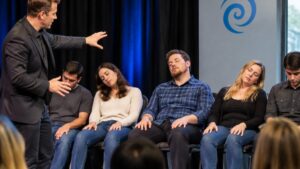
Stage hypnosis is a comedy and mentalism performance in which a hypnotist works with willing volunteers on stage while the audience watches. The volunteers are the center of the show, so they need to get up, move around and respond. Everyone else sits and watches.
That structure creates three common access points:
- Getting to the stage. Volunteers must climb up and find their place.
- Hearing and seeing the performance. Jokes, instructions and cues depend on sound and sight.
- Participating comfortably. Some guests want to take part; others need a clear way to say no.
Knowing where these barriers sit helps you plan for them before the day.
Physical Accessibility: Venue, Stage Access and Performer Movement
Physical access is the first thing to verify, because a single step in the wrong place can remove a guest from the show entirely. The goal is a continuous step-free path from the parking area to the seat, and from the seat to the stage for anyone who volunteers.
Walk the route yourself, in this order:
- Parking to entrance. Confirm where accessible parking stalls sit relative to the accessible entrance, and whether the path between them is paved, lit and free of curbs. A ramp at the front door does not help if the route from the lot crosses a grass strip.
- Entrance to seating. Check door widths and thresholds. Ask the venue for its actual door and aisle measurements rather than estimating.
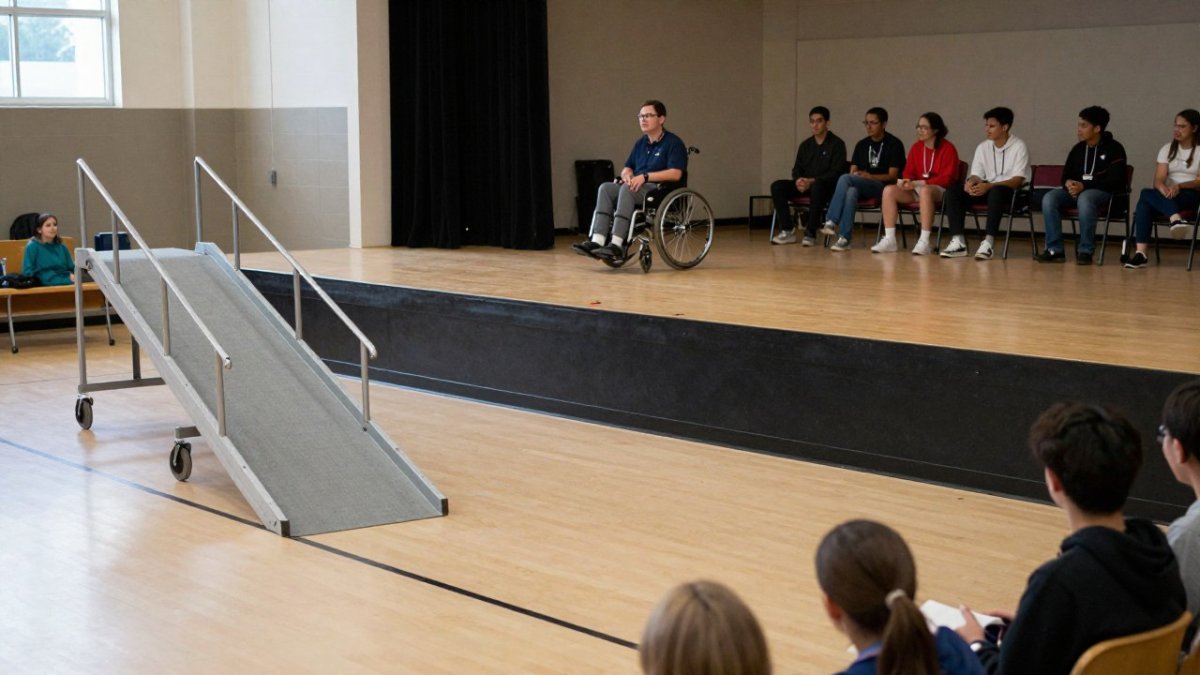
- Seating to stage. This is the route a volunteer takes. It should be step-free, marked, and wide enough for a mobility device. If the only route to the stage is a set of stairs, ask whether a ramp can be added or whether the show can be staged at floor level.
- Restrooms. Confirm accessible restrooms are on the same level as the auditorium and note the distance. Guests should not have to leave the building or cross a service corridor to find one.
For the stage itself, ask the venue three specific questions: the height of the stage deck, whether a code-compliant ramp or lift exists, and the ramp’s width and slope. A steep ramp is a barrier even when it exists. If the venue has no ramp, a portable threshold ramp can work for a low stage, but confirm the load rating and that it can be secured so it does not shift when someone rolls onto it.
Performer movement matters too. Agree in advance where volunteers will stand, and keep the floor clear of loose cables and anything that crosses a walkway.
Stage Dimensions, Layout and Chair Arrangements
Stage size changes what is possible. A small platform may fit only a few volunteers, while a larger one gives room for a wheelchair user to take part alongside others. Confirm the stage depth and width with your venue before you book, and ask whether the stage has a lip or edge that would stop a chair from rolling on.
Chair arrangements count too. Place accessible seats near the front and along the aisle so guests can see clearly without needing to move, and leave a clear path from the seats to the stage for volunteers who need extra time. Spread accessible seating through the room rather than clustering it in one corner at the back, clustering signals that guests were an afterthought.
Watch out: a venue that says it is “accessible” may mean only that the building has a ramp at one entrance. Ask for the specific route and measurements in writing, and confirm them again on the day of the show, because furniture and equipment get moved between the site visit and the event.
The table below summarises the key physical access checks for a stage hypnosis show.
| Check | What to confirm | Why it matters |
|---|---|---|
| Parking to entrance | Accessible stalls and a paved, lit route | A ramp at the door does not help if the route crosses grass |
| Entrance to seating | Door widths and thresholds, measured | Estimates can hide a barrier |
| Seating to stage | Step-free, marked, wide enough for a mobility device | This is the route volunteers take |
| Restrooms | On the auditorium level, short distance | Guests should not leave the building to find one |
| Stage ramp | Width and slope, code-compliant | A steep ramp is still a barrier |
| Portable ramp | Load rating and secured position | Prevents shifting under a rolling chair |
Sensory Accessibility: Sound, Lighting and Visibility
Sound and light are central to a stage show, but they can be overwhelming. Guests with sensory sensitivities, hearing differences or visual needs may struggle if nothing is planned. The fix is to plan the sensory environment before the show and to tell guests what to expect.
For sound, ask whether a wireless microphone and a main speaker system will cover the whole room, and test the audio before guests arrive. Confirm that the performer’s voice carries to the back row without shouting or distortion.
For lighting, bright spotlights and strobe-style effects are part of many shows. Ask the performer in advance what lighting is used, and whether the house lights can stay at a softer level. Keep the stage lit enough that guests can see volunteers and body language.
Visibility also covers the screen or any slides. Use large text, high contrast and short phrases. If an announcement or instruction is written on screen, read it aloud as well, so guests who cannot see the screen are not left out.
Plan a quiet space. Identify a room or a corner away from the speakers where a guest can step out and regulate, and make sure staff know where it is. Tell the audience at the start that they can leave and return at any time without explanation. For school groups, let teachers know in advance so a student can step out without drawing attention.
Finally, send advance information. A short pre-event note describing the show’s length, the use of music and lighting, whether volunteers are asked to come on stage, and who to contact with access requests lets guests decide what they need before they arrive. That single step does more for sensory accessibility than any equipment change.
Inclusive Audience Participation: Voluntary, Comfortable and Opt-Out Options
Participation should always be voluntary. Tell the audience clearly, before the show starts, that taking part is optional and that anyone can stay seated.
Make the opt-out easy to use. A guest who does not want to volunteer should not feel singled out. Some practical steps help:
- Announce that participation is optional at the start.
- Invite volunteers with a simple raised hand, not a loud call-out.
- Allow someone to decline quietly at any point.
- Keep a second option for guests who want to help in a low-key way.
For students, this matters a lot. A teenager who feels pressure to perform may disengage for the rest of the event. A clear, relaxed invitation keeps the mood positive for everyone.
Safety, Consent and Participant Wellbeing During the Show
Safety and consent go hand in hand. Tasteful performance is a priority for the show, and it is worth agreeing with the event organizer on what content suits your audience. Before the show, agree with the event organizer on what content is appropriate for your audience and how volunteers will be treated.
Plan for people who might feel unwell. Have a staff member near the stage who knows how to step in, and make sure there is a quiet space nearby where a guest can take a break. Let the performer know about any known needs, such as a student with epilepsy who is sensitive to flashing light, so the lighting can be adjusted.
Confirm with your administrators what insurance and policy requirements apply to live performances on your property before booking.
Your Accessibility Checklist Before Booking Your Next Show
Use this list when you talk to a performer and your venue:
- Step-free route from parking and entrances to seating
- Ramp or lift to the stage, with enough width
- Accessible seating spread across the room, including near the front
- Clear floor space for performer movement and volunteer access
- Wireless microphone and speakers tested to reach the back row
- Lighting plan shared in advance, with a softer option if needed
- Large, high-contrast text for any slides or on-screen instructions
- Clear statement that participation is voluntary, with an easy opt-out
- Staff member on hand and a quiet space for guests who need a break
- Known participant needs shared with the performer ahead of time
Accessibility is planning work, and most of it happens before the show day. Raise these points early, and confirm them in writing with your venue. If you want to talk through your room and your audience, you can reach out to Dusty Satterlee for a conversation about the show format and what will work best for your group. Pricing depends on the date, the length of the show and the travel involved, so ask for a quote tailored to your event.
Book A Show
Frequently Asked Questions
How do stage hypnosis shows work?
A stage hypnosis show relies on willing volunteers who come up on stage and follow suggestions from the performer. Participation is voluntary, and audience members can sit down at any point. Before the show, a good performer explains the format so guests know what to expect and can decide whether they want to take part. Asking the performer to describe the show structure in advance helps event planners set accessible expectations for everyone in the room.
What accessibility features should a venue provide for a stage hypnosis show?
Venues should offer step-free access to the stage or a clearly marked alternative for performers and volunteers using wheelchairs or mobility aids. Seating should include wheelchair spaces and aisles wide enough for mobility devices. Lighting should be adequate for audience members with low vision, without sudden flashes. Ask the performer about stage height, the distance volunteers must walk, and whether chairs can be moved, since these details decide whether a participant can join comfortably.
Can audience members with sensory sensitivities enjoy a stage hypnosis show?
Yes, with planning. Ask the performer about volume levels, sudden sounds, and lighting changes, and request a quieter seating area near an exit if needed. Some guests may prefer to watch without participating, which should always be an option. Event planners can share a short description of the show with registered guests beforehand, so attendees know what sounds and lighting to expect and can decide how close they want to sit.
What should event planners ask a hypnotist about accessibility?
Ask the performer what stage size, microphone and sound, lighting, and power or setup needs the show requires. Confirm how volunteers are chosen and whether participation is opt-in only. Ask how the performer handles a volunteer who becomes uncomfortable, and whether they can adjust volume, pacing, or the intensity of suggestions for a younger or mixed-age audience. Request written confirmation of these details before signing a contract.
